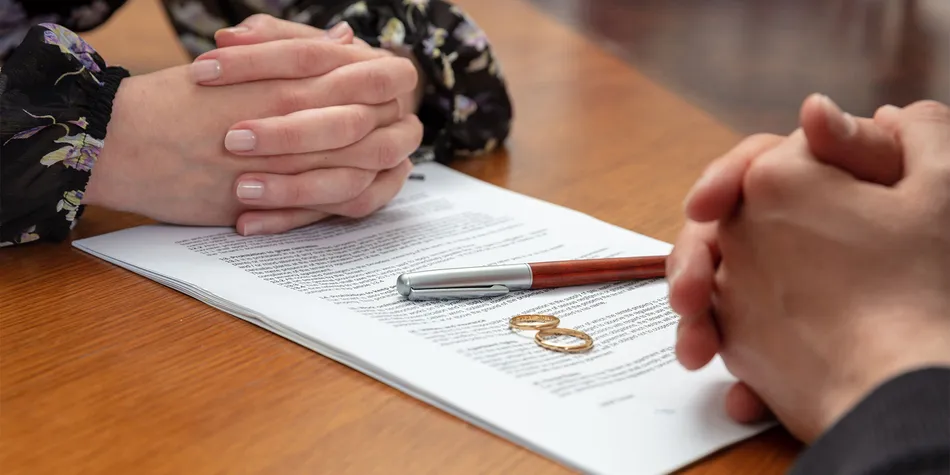
Divorce and pensions: should all married couples have a plan?

James brings experience from the BBC and commercial radio to our award-winning video and audio team, where he produces our always-on podcasts and presents Which? Money, our weekly personal finance podcast.

Check your annuity options
Speak to HUB Financial Solutions to help you compare the options available across the whole market.
Find out moreIf you take out an annuity as a result of using the service from HUB Financial Solutions, Which? will earn a commission to help fund its not-for-profit mission.
The number of pensioners getting divorced is on the rise, but hardly any of us actually understand what happens to our pensions when a marriage ends.
In this episode, Which? pensions expert Holly Lanyon reveals the results of a Which? Survey which shows that just 3% of married couples have talked about what would happen to their pensions if they got divorced – compared to 50% who had spoken about what would happen upon death.
Holly explains the different options for how pensions can be split on divorce, including pension sharing and pension offsetting, and why it’s so important for married couples to understand the rules.
Holly shares some more data that shows that the number of pensioners in poverty is on the rise, with divorced retirees – particularly women – making up a greater number than married couples.
Plus, James Buchan from the Which? legal team outlines the logistics of how a divorce works, and how it can affect your will and power of attorney.
James Rowe: The number of pensioners getting divorced is on the rise, but hardly any of us actually understand what happens to our pensions when we end a marriage. Let's find out more about this on this episode of Which Money?
Hello, it's James in the Which? studio. Thanks again to Katfor filling in last week as we looked ahead to the budget. Speaking of which, we'll be with you on Wednesday evening next week as we round up all the big headlines from John Healey's first budget speech as Chancellor.
But today, something a bit different. We're talking about the effects of divorce on your finances, particularly come retirement. Joining me in the studio is researcher from Which Money, Holly Lanyon. Holly, hello.
Holly Lanyon: Hi, James.
James Rowe: Nice to have you back with us. And from the Which? legal team, James Buchan. James, hello.
James Buchan: Hi, James. How you doing?
James Rowe: Very good, thanks. James of course not in the studio by the sounds of things, but joining us down the line.
Holly, we talk about retirement a lot here on the podcast. You write about it a lot for the website as well. But we rarely talk about how divorce can affect pensions. And it's not just you and me who don't talk about this, but you've been hearing from Which? members as well. They don't tend to talk about it either, do they?
Holly Lanyon: Yeah, exactly. So, I ran some research back in March. We surveyed 758 Which? Connect members who live with a partner, and we found that just 3% of them had talked about what would happen to their pensions if they divorce or separate. And to put that figure in context, half of them have spoken with their partner about what would happen to their pensions and retirement savings if they died. So it's not that they're not talking about them at all, but this particular issue of what would happen if you broke up is something that, yeah, people really don't want to talk about, it seems.
James Rowe: Yeah, 3% as you said from those who you spoke to. What's the risk then if people haven't had this conversation or don't actually understand what the rules are?
Holly Lanyon: Well, pensions are often – aside from a house if you own property – pensions are likely to be one of probably the most valuable assets that you might be sharing when it comes to divorce. If they're not fairly divided, especially depending on the age at which you separate, it could put you – you could not have much time left while you're working to build up adequate retirement savings. And, yeah, you could find it, yeah, you really haven't got enough saved for retirement depending on how pensions have been have been shared when you split.
James Rowe: James, why do you think so few people have actually considered how pensions play into a divorce?
James Buchan: I think there's a few factors. I think the first one is the fact that people probably don't really understand pensions. So, I think that's – that's kind of fair comment that they don't really know what their pension is, how it works, what happens when they get older and they need to live on their pension or take their pension and draw down, and all these words that we hear. So I think that there's a bit of a misunderstanding about pensions generally.
And I think another issue is people – it's one of those issues, it's not particularly romantic issue you want to sit and talk about with your husband or wife in terms of, you know, if the marriage did fall apart, what might happen with our pension? I just think it's one of those topics people – people just don't talk about it. In that respect, I think Holly's right.
They tend to talk about what would happen with their pension on death more so than what would happen if the marriage did kind of, you know, come to an end. So I think it's probably those are the two main factors: one, not really understanding, and two is not – a reluctance.
James Rowe: Yeah, I guess it's – it's more natural to talk about finances, what would happen to finances upon death, because we all know it's going to happen. But with divorce, you're almost kind of hoping that it's not – that it's not going to happen.
Holly, aside from your research as well, there's some additional research from Bristol University which is quite interesting as well. Do you want to just talk us through some of that, because that might help put some of this into context as well?
Holly Lanyon: Yeah, it's a really interesting study back from 2023. I think it's like one of the first or one of the biggest representative studies of how assets are shared in divorce. This was looking at people in England and Wales. So they did a big survey, around 2,500 divorcées about how they'd shared assets.
And they found that only 11% of people who were divorced that had a pension that they hadn't started taking yet had actually made an arrangement for it to be shared. So, yeah, even when it comes to the point of separating, a lot of people aren't putting provisions in place for how they'll share – how they'll share their pensions.
And, you know, what James was just saying speaks to it exactly. So they said a big part of the problem was lack of awareness and understanding about pensions in general. So a quarter of people didn't know whether their ex had had a pension, and a third of those who hadn't started taking their own pension didn't know the value of it yet. So I think that first step is just, yeah, understanding your retirement finances, both your own and your partner's.
James Rowe: And I guess understanding the finances – or at least the pension part of your spouse, and then once you are divorced, your former partner. But as you said, a third of those who had divorced and hadn't started taking money from the pension didn't know the value of their own pot, which I guess is a bit of an issue to begin with, and perhaps comes back to some of the conversations we've had on the podcast before around pension awareness more generally. I think that's – that's the first hurdle to overcome, isn't it?
Holly Lanyon: Yeah, absolutely. And especially since the introduction of automatic enrolment, a lot of us are accumulating multiple pots as we move between jobs. It's not always easy to keep track of them, not always easy to kind of, yeah – you may not have a handle on who's got your pension, how much is in it, how do I find information about it.
So, yeah, I think that's exactly – all of that feeds into it as well.
James Rowe: So maybe some financial admin around pensions just generally to do for a lot of us to get things shipshape.
James, as we said before, nobody naturally wants to get divorced. It's not on the bucket list, is it? Should all married couples have a plan just in case their marriage does end in divorce? Would it be helpful to have these conversations up front?
James Buchan: Yeah, I mean, some couples are quite private with each other about their finances. Not everybody is as open and not everybody talks about their finances. And I think, just picking up on one thing before I expand on that what Holly just said, pensions can be notoriously difficult to value. So, particularly if it's an older-style pension, or a local government pension, or something along those lines, a teachers' pension, they can be really, really difficult to value and quite expensive in some circumstances. So it doesn't surprise me that people don't have an understanding of what a pension might be worth, because it's not always clear.
But, yeah, in terms of a plan, I mean, I don't think it's a bad idea for spouses to have an understanding of what their assets are as a couple and what they might consider they want to do if their marriage does come to an end. And that might change over time depending on lots of factors – like if you have children, and if you have one party that has particularly more wealth than the other.
So I think it's, you know, it's a good idea to have an understanding of what the collective assets are, if you like, and try and somehow figure out a plan as to what might happen on divorce. But I just don't think it's something that people really talk about or or even feel there's a want or a desire to talk about. So it's a difficult one, but, yes, I would always say if you can have that conversation and you can plan, then please do.
Holly Lanyon: I think as well, it's about – exactly like that conversation about what you might have when you separate is not something that a lot of people might want to have. But just understanding how choices that you're making in the relationship might affect your pensions more generally. So, for example, if one of you is taking time off work to care for children or a family member, having a conversation about like, "Oh, okay. How is that going to affect both of our retirement savings?"
We know it's not very common, but you can contribute to a partner's pension. In the same survey, we asked about that. Again, I think only about 6% had either contributed or had a partner contribute to their pension. But there are options if – if you're making choices jointly that are kind of affecting your pensions differently, there are things you can do to try and mitigate that in the relationship, not necessarily looking at it through the lens of divorce at that time.
James Rowe: Very interesting. And I guess something you mentioned before, Holly, but just to pick it up, and James, just to get your thoughts on it as well, the importance of thinking about pensions within divorce is so big because for a lot of people, a pension – maybe aside from property – is one of somebody's most valuable assets, isn't it?
James Buchan: Yeah, it is. I mean, for most people you'll have, you know, like you say, you'll have a property which is usually your biggest asset, and then it is your pensions. They are a huge asset that people seem to forget about, really. So it's important that you have, you know, very much an understanding, certainly of your own pension's wealth, whatever value, whatever it might be, but also consider, you know, for example, like Holly said there, you may have a spouse who has a huge pension because they've had a bigger contribution from their employers, or if there's been a break in somebody's employment if they've been caring for children or stayed at home or something along those lines, you can have quite an inequality in terms of pension contributions.
Holly Lanyon: Yeah, I was just going to say I can completely see where the statistics that Holly was talking about were coming from, because I think a lot of the times in divorce, traditionally there's been a desire to maintain the matrimonial home, which has kind of always been the main think, particularly if you have children involved. And then that, you know, if you have a spouse, traditionally women who have stayed at home, looked after the children, have taken career breaks, for a start, their earning capacity might not be as much as their former husbands. And they don't then take a share of pension, so they can leave themselves in a position where they haven't earned as much because they haven't been working, they haven't contributed to their pension, and then in later life, they can't earn as much because of all those things, and then they end up in the situation that Holly was describing.
James Buchan: Yeah, I think it's also really important to remember that this applies to men as well as women. It's not – it's not just exclusively, it applies to both.
James Rowe: I wonder if we should now address what people's options are for how pensions can be split upon divorce? I appreciate we've not actually covered that yet. Who am I going to go to for this? Holly, James? James, I imagine given your previous life in private practice, you may be the best person for this.
James Buchan: It's a long time since I took any family law. I think I may have even been a trainee, and that was a very long time ago.
But, yeah, I mean, there's different ways. You can have pension sharing annexes where the pension can in effect can stay as one pot, but it can be kind of – an invisible line, if you like, can be placed down. So it doesn't have to be split up, or it can be split up. I'm sure – I mean, there are lots of other options now, I'm sure, than what what there used to be years ago, which, Holly, you might have more understanding about if you've gone through any of the research. You might not.
Holly Lanyon: I think pension sharing is the most common. Then there's, yeah, pension offsetting, where people might keep their own pension, but make up with it with the value of other assets. And then pension attachment, which I think is much less common these days. That's where you don't share the pension until you start taking it. So when you start taking an income from the pension, part of it would go to your – to your ex-partner. In that instance, I think when the person whose pension it is dies, the payment stops. So I think it's much less commonly used these days.
James Rowe: So there are different options there for how your pension, your previous partner's pension would be split. And I guess, it would depend on which type of divorce you get as well, because one divorce isn't exactly the same as another. They're never similar, are they, James? You can have a different mechanism for how a divorce goes through.
James Buchan: Yes, you can. It's always really important to remember that there's three elements to when you do actually bring your marriage to an end and you divorce. There's the actual divorce itself, the dissolution of the marriage. You've then got the financial, which used to be or I think still is called the ancillary relief, which is a bit of a mouthful if you've not said it before. And then obviously, you've got children, which need to be factored in as well. They're all quite separate and quite distinct.
And sometimes there can be a real rush to get the divorce sorted, get the divorce sorted, and people don't actually deal with the pensions or the finances or those sort of things. And there's been quite a lot of cases where years later on down the line, the former spouse has come back for a bite at the apple because the finances have changed, and the court has allowed them to do that. So it's always really important to get an agreement drawn up that you can get stamped by the court to have them approve your financial settlement which applies any future claims and all those sorts of things.
But I think what's really – it's really important, I had a case long, long time ago where a couple were in the process of divorcing and the husband wanted to remarry. He'd met somebody else and wanted to remarry, and he wanted to get divorced so he could remarry, but the pension elements hadn't been sorted out. And the court wouldn't allow the divorce, because if he did remarry, it would then prejudice his former spouse against the pension, because it's more likely that the pension company would pay out to the new spouse. So they wouldn't allow the divorce to actually take place until that element of the divorce had been resolved.
And that's really important that if you do rush to go through to a divorce and then somebody remarries, you are then prejudiced potentially against claiming that pension later on down the line. So it's something to really think about. It's really important before you apply for that decree absolute that you do make sure that the finances have been thought about and have been resolved and have been rubber-stamped by the court if need be.
Holly Lanyon: And like James was saying earlier, valuing a pension can often be quite a complicated and long-winded process. And it might involve, you know, getting professionals involved. They found in the Fair Shares study that where couples didn't use a lawyer, pensions were less likely to be to be adequately addressed. There are, I think, pensions on divorce experts, they're called, who are specially trained in this process of valuing complex pensions and making recommendations for how you can split them fairly. So it may, yeah, may take a little bit longer and potentially be more expensive, but I think it can be useful.
James Rowe: And Holly, on James's point around the speed of how quickly a divorce can go through from beginning to end, I guess there's more of a move now towards no-fault divorces as well, which there's some caution to be had there as well, because naturally they can go through a lot quicker. But I guess with a complicated pension to decide how that's going to be split, you're at risk of maybe not splitting it as equally as you might want it to be split.
Holly Lanyon: Yeah, that was one – that was one of the potential concerns raised by LCP in their report. Obviously, I think, no-fault divorces, I think, bring a lot of positives and they were not – they were not denying that. But just acknowledging that as people do have a kind of quicker and smoother divorce process, it may become more likely that pensions are overlooked or, yeah, not properly considered, because it does – it is a more complicated and long-winded process.
James Rowe: James, just to come back to you, you mentioned the decree absolute earlier on. For some people, as we've been talking today, if they have reached that point or they've been divorced for a few years and have now understood there are different ways of sharing a pension upon divorce, once you've had that final legal document, is that it? Is that case closed? You can't go back and try and get more of your fair share?
James Buchan: No, not necessarily. And I think if you've resolved – I think if you've resolved the finances and everything has been done above board, nobody's been hiding assets and all those sorts of things, and you have a document that's been rubber-stamped by the court, if you like, years down the line if things change significantly, spouse could still come back to the court and ask for that to be amended. There's nothing to stop them from doing that. I think the circumstances would have to be exceptional.
But, yeah, definitely. I mean, the UK system is – you know, England and Wales system is based on need, and that's why whilst prenuptial agreements are becoming more persuasive, if there is a need-based argument, the court will always generally go down on the side of that need.
So, yeah, I mean, just – you need to make sure you have everything in place. But if the situation changes later on down the line, there's nothing to prevent the spouse coming back and trying to challenge that – that agreement. But like I said, I think you would need exceptional circumstances. I think in most cases, if, you know, it's all been done above board, shall we say, at the time, and, you know, the sharing was equal and agreed and both sides had representation and those sorts of things, it's unlikely a court would allow that to be reopened and amended. But in exceptional circumstances, they will do it.
James Rowe: And just listening to you there, James, these things can be very complicated. So seeking any form or, you know, some good-quality legal advice would be recommended for – for anything to do with this, would you say?
James Buchan: Yeah, I would say so. I mean, I think even if you decide – I think what my wife is a solicitor in private practice, she's a partner in a firm, and she was explaining that, you know, they're finding that a lot more people are undertaking their own divorces, you know, particularly with the no-fault that's now been introduced a few years ago. But they are then going to get help to deal with the financial side and any children issues, because they're the ones where they can be quite complex and you do need kind of dispassionate negotiation, whereas sometimes with a divorce, you know, it can be quite emotional and people think with their emotions rather than thinking clearly. So, yeah, if you're not sure, or even if you think feel like you are sure, you know, going and get an hour or a couple of hours of advice might be well worth it in the long run, because it may uncover things or give you ideas or thoughts that you've not thought about in the slightest.
Holly Lanyon: Yeah, and it's worth saying as well that the government's currently looking at reforming the rules around divorce and separation in England and Wales, specifically requiring courts to take pensions into account when making financial orders so that they're not overlooked.
James Rowe: James, I think it might be worth a quick word here on wills and powers of attorney. I know it's not specifically related to pensions, but I guess it ties into divorce, especially if people have already had them written up and then they do get divorced. Would these get thrown out? Would you have to write them all again? What can you tell us about these?
James Buchan: No, not necessarily. But I think it's really important that if you are – if your marriage has come to an end and you're in the process of divorcing, until your decree absolute comes through, you are still married. So if you have wills and you own property and it leaves everything to your spouse, they will stay in effect until the point where the decree absolute goes through. So some people forget that if they're at a point where the marriage has come to an end, the divorce is in the process, they just forget that, "Actually, I own a property and if I die, the surviving partner will own the whole property, or everything in my will goes to the surviving partner." So review your will and review the property status.
Once the decree absolute goes through, your will isn't revoked by a divorce in the same way it's revoked by a marriage. But it does treat the former spouse quite severely as though they've died. So any appointment of executorships and any gifts or residue that's left to the spouse, it would fail. But the will is still valid. So a divorce doesn't invalidate a will, but the actual kind of – anything that's left to the spouse or any mention of them is treated as – as void.
In terms of power of attorney, it's slightly different. So the appointment of the spouse as an attorney will come to an end on divorce when the absolute comes through. But you can add into the power of attorney document that you would like them to continue, and some people do. So if they have, you know, friendly divorces, as it were, it may be that they want their – their partner to continue as an attorney. But usually on divorce, the attorney-ship will come to an end at that point, and at that point you need to notify the Office of the Public Guardian and they will then mark that on the document itself.
Holly Lanyon: It's worth noting as well that the laws around wills and power of attorney do differ slightly in the devolved nations. So, yeah, worth paying attention to how different rules apply there.
James Rowe: Absolutely. And perhaps great timing as well to mention, if you are requiring of a will or a power of attorney, whatever stage in life you are, you can currently get up to 30% off a will or a power of attorney via Which? Wills. There's a link in the show notes to find out more.
But I think we're probably going to wrap up in just a second. I'll give you both an opportunity just to – for any final thoughts or just to reiterate any final points. Anything from you, Holly?
Holly Lanyon: Yeah, I guess the takeaway from this conversation is not that you have to go and have a really stressful conversation with your partner about what would happen to your pension, but just take those first steps of checking out your own pension, chatting to your partner about theirs, and kind of, yeah, taking stock jointly of your – of your retirement savings as a first step.
James Rowe: Sound advice. What about you, James?
James Buchan: Yeah, I agree with Holly. I think it's being, if you can, being more open in terms of, you know, not just pensions, but finances generally, and having ideas of what you might want to do and how you might want to carve things up, as it were, being quite brutal in that respect. But I think, you know, I think people don't – it's just something people don't like to discuss, and it's kind of getting over that maybe initial uncomfortable feeling and trying – trying to figure out what how you would work it if, you know, that did come to an end.
Holly Lanyon: And actually, yeah, James, just – just made me think of one other thing. Just being aware of the options is a good first step. So, yeah, I think four in 10 UK adults don't know that you can share a pension on divorce. That was some research from the Money and Pensions Service. So – so just at the outset, yeah, having listened to this podcast, understanding what the options are is – is already a good step in the right direction.
James Rowe: Absolutely. And you can read more about Holly's research and Holly's story about how divorce can affect your pensions on the Which? website. There'll be a link to that in the show notes as well as that link to get up to 30% off a will writing service and a power of attorney writing service via Which? Wills.
But for now, James, thanks very much for your time.
James Buchan: Thank you very much, both of you.
James Rowe: And Holly, thank you.
Holly Lanyon: Thank you.
James Rowe: That brings to an end another podcast from Which? There's loads more for you to read about everything we discussed today, just head to the episode description for more useful everyday advice. There, you'll also find an exclusive offer for podcast listeners like you to become a Which? member for 50% off the usual price, giving you access to our product reviews, our app, 1-on-1 personalised buying advice, and every issue of Which? magazine across the year. Plus, your membership helps us to make life simpler, fairer, and safer for everyone.
If you'd like to know when we release a new episode, then make sure you press subscribe wherever you're listening. That way, you can be one of the first to listen. And for any questions, comments, or anything in between, follow us on social media @WhichUK or email us podcasts@which.co.uk.
Goodbye.
Take control of your retirement planning
free newsletter
Get to grips with pensions, boost your retirement income and enjoy the lifestyle you want with our expert tips.
Our Retirement Planning newsletter delivers free retirement-related content, along with offers from third parties and details of Which? Group products and services.
More podcasts from Which?
The Which? podcast showcases the best content from across our website and magazine.
In our Which? Money episodes, released on Fridays, we give advice to help you get on top of your bills and tackle the issues hitting your pocket, whether that's spiralling energy costs or your weekly food shop.
The Which? Shorts podcasts offer you a free insight into some of our favourite articles from our suite of magazines.
Plus, keep an eye out for bonus episodes that tackle important issues, from motoring and tech to health and wellbeing and travel.
How to listen to the Which? podcast
We're always releasing new episodes, and the podcast is available from wherever you usually get your podcasts.
Subscribe using one of the links below, or click this link on your mobile to find us in your favourite podcast app.
As part of your subscription, Which? members also get access to exclusive podcasts.
- Listen to member-exclusive podcasts on our website
- Listen on the go by downloading our app on Google Play
- Listen on the go by downloading our app from the App Store
If you're not already a member, podcast listeners can get 50% off the first year of an annual membership.
What’s your retirement status?
Select the option that best describes your current situation.