Where to next?
Discover inspiring destinations, recommended by our in-house travel experts. Know the best places to go, who to book with and how to pay less.
Join Which? Travel
Trevor Baker has almost 20 years experience as a travel writer, having lived in Spain before becoming an award-winning investigative journalist.

Last year, I was browsing prices on the Tui website, looking at pictures of tempting swimming pools and luxurious hotel rooms, when I saw an extraordinary message.
‘The cost of your holiday has increased,’ a pop-up announced immediately after I clicked on it. ‘We’re sorry to say the price for your holiday has gone up by £722.62.’
That’s an astonishing amount of money. The same flights, the same transfers, the same shimmering pool view suddenly cost well over £700 more than it did a few seconds before. How can that possibly be right?
‘It’s because this trip uses flights from a third-party airline’, the pop-up went on to explain. ‘We receive the latest prices from the airline a few times each day, but the price might change when we come to request the actual seats. Your new total is shown in the holiday summary.’
The travel industry likes to call this business model ‘dynamic pricing’. That means you pay more when demand is higher and, in theory, less when demand is lower. But if it’s so ‘dynamic’, why have I – someone who looks at hundreds of holiday prices a year – always stumbled across prices going up, never down?
In summer 2026, we collected more than 2,000 prices from Expedia, Lastminute.com, Loveholidays, On the Beach and Tui – some of the UK’s largest holiday firms – to find out.
This article first appeared in Which? Travel magazine. We don't accept freebies from travel companies, airlines, or hotels, so you can be sure that our investigations, recommendations, and reviews are completely unbiased.
Discover inspiring destinations, recommended by our in-house travel experts. Know the best places to go, who to book with and how to pay less.
Join Which? TravelSome of the holiday prices we looked at moved very dynamically indeed: 33 out of 472 Loveholidays packages leapt in price with the click of a mouse, as did 30 out of 466 Tui packages – some by hundreds of pounds. By coincidence, the highest price surge we found was £580 for both Loveholidays and Tui.
In total, 6% of Tui holidays increased after the first page. For Loveholidays, it was 7%. If this were repeated across all bookings, it would be millions of holidays.
As this is due to ‘dynamic pricing’, you’d rightly expect that a similar number of holidays would drop in price. Two did. Two holidays from more than 2,000 we looked at. Those were both from Tui. Not one of Loveholiday’s prices went down.
Tui includes a disclaimer that ‘prices may update at the checkout depending on availability’, but it’s much smaller than the bold headline price. Loveholidays has no such disclaimer. It told us: ‘We make it clear that prices shown in our search results are “from” the amount shown.’ But we think it’s far from clear.
Even if we do accept that ‘prices may update’, would you be happy if a trip turned out to be hundreds of pounds more expensive than it said on the advert?
Unsurprisingly, holiday firms aren’t allowed to advertise holidays for the wrong price, even if it’s accidental. Tesco can’t put a 50p sticker on a bag of potatoes, then hit you with a £1 charge at the till. Nor can Tui advertise a holiday for £1,000, then try to sell it for £1,700.
None of the prices we looked at for Expedia, Lastminute.com or On the Beach increased. If they can produce consistently accurate prices, why can’t Loveholidays and Tui?
Tui told us: ‘The vast majority of prices displayed on our website remain unchanged throughout the booking process. In the examples shared with us, a significant proportion related to holidays using third-party airlines, where changes in flight availability or pricing are the most likely cause of any difference between the initial search result and the final booking price.’ It also said that it was ‘continuing to make improvements aimed at reducing the likelihood of price differences appearing during the booking process’.
Loveholidays told us that the problem was due to ‘trillions of package holiday combinations processed each day’. It said it does its best to ensure that prices are updated, but ‘on a small number of occasions’, prices may change after the search results page.
Neither addressed why prices so rarely go down, if they’re dynamic.
The argument that it’s just too complicated to give people accurate prices is one we’ve heard before.
In Which? Travel magazine in November last year, we reported that major holiday companies weren’t including hundreds of pounds’ worth of so-called ‘resort fees’ in their pricing for trips to the US. These are mandatory fees that hotels in places such as Las Vegas add on – after your initial payment – so they can advertise with lower prices.
When we pointed out that a new law, the Digital Markets, Competition and Consumers (DMCC) Act, would make this unlawful in the UK, holiday firms stalled and told us they were waiting for the Competition and Markets Authority (CMA) to confirm its guidance. That’s despite the fact that the CMA had already explicitly used ‘resort fees’ as an example of charges that would now have to be properly shown in the overall cost.
It was only when the CMA confirmed that it had been right in the first place – and after many, many emails from us – that BA Holidays, Loveholidays, On the Beach and Tui all discovered that it was possible to include all mandatory fees, as the law demands, after all.
This isn’t the only time we’ve caught travel companies making dubious claims about their prices.
A couple of years ago, Booking.com, Expedia and Hotels.com all had huge numbers of ‘mobile booking’ discounts. They said it was cheaper to book on your phone than on a desktop. Essentially, they would give you a discount for squinting at a hotel room on your phone screen and taking a chance that it’s OK. They really don’t want you to go away and think about it, before booking elsewhere.
The only problem was that, when we checked Expedia and Hotels.com, in many cases the prices were exactly the same, regardless of whether you used a phone or a desktop. When we pointed this out to them, they both swiftly removed these so-called mobile ‘discounts’.
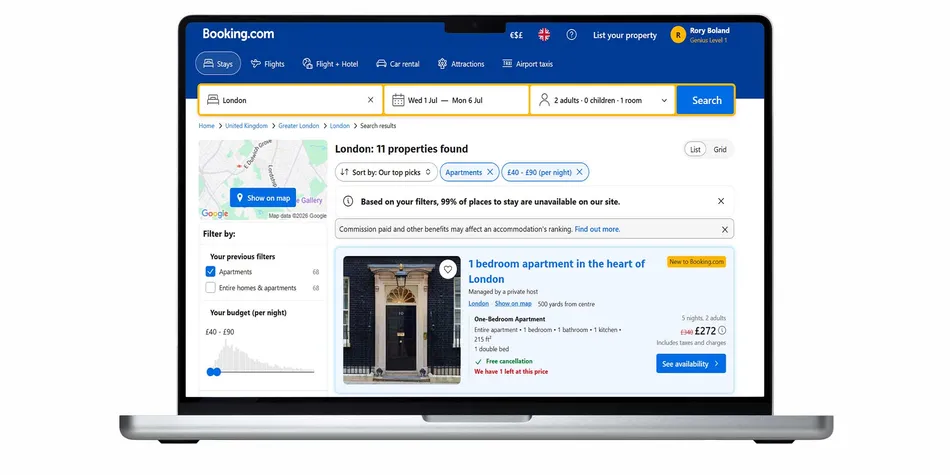
At the time, the Booking.com deals we looked at were all absolutely genuine. However, when we carried out spot checks in July, three of the 10 claimed savings didn’t exist. One of the three was actually more expensive to book on a mobile phone than it was on a desktop. When we pointed this out, Booking.com sent us a bland statement, which gave no indication that it was planning to do anything about it.
Last year we also reported hotel chains Accor, Hilton and Travelodge – as well as Booking.com – after catching them claiming ‘from’ prices for a night’s stay that simply weren’t real or were almost impossible to attain. The ASA followed up on our research with its own and ruled against them all.
Increasingly, we’re reporting travel firms to regulators, because they refuse to do the right thing voluntarily.
We recently convinced the CMA to launch an investigation into Ryanair charging parents to sit next to their children. The airline immediately folded and scrapped its unfair fees.
We also complained to the ASA about easyJet’s ridiculous claim that you could take a large cabin bag onboard ‘from £5.99’. Our research didn’t find any flights where you could take a bag onboard for less than £20. We won again, although the airline just changed its website to say that cabin bag prices ‘vary’.
In July last year, the ASA ruled against Loveholidays, after customers complained about two trips shooting up in price during the booking process. We reported the £722 Tui price jump – mentioned at the beginning of this article – to the ASA. In January, it agreed with us that the claim was misleading, ruling against the holiday giant.
Following our latest research, we’ll ask the ASA to investigate why the same problems are still happening a year after our complaint. We’ll also send it evidence of Booking.com’s non-existent ‘mobile offers’.
While we wait for its ruling – and for all the regulators to get their acts together – we’ll carry on fighting for travel rights in any way we can.
In the past year, I’ve spent almost as much time writing reports for travel regulators as I have investigations for this magazine. I’ve asked the Competition and Markets Authority (CMA) and Ofcom to investigate how Booking.com handles fraud, and the Advertising Standards Authority (ASA) to look at the special offers mentioned in this article.
I’ve reported Ryanair to the CMA, and easyJet and Tui to the ASA. In the past few years, colleagues have reported Accor, Hilton and Travelodge to the ASA.
This is part of what Which? does – to hold travel firms to account and make holidays better for everyone. Wouldn’t it be nice, though, if the holiday firms would fix the problems we highlight themselves, without having to get the regulator involved at all?