Avoid the crowds at Spain’s lesser-known Costas

Trevor Baker has almost 20 years experience as a travel writer, having lived in Spain before becoming an award-winning investigative journalist.

I lived on Spain’s Costa Blanca for six years – here’s why I think you should try a different part of the country for your next summer trip.
Last year around 96.8 million foreign tourists visited Spain, and most of them stuck to a few hotspots around the coast.
But away from favourites like Benidorm on the Costa Blanca or Torremolinos on the Costa del Sol, there are other parts of the country where beaches back on to dunes and wild grass, rather than concrete.
These are some of the 'costas' where there’s still space to spread out your towel – and one that we recommend above all the rest.
Costa de la Luz

If you head far enough west from Malaga you eventually leave the Mediterranean – and most of its tourists – behind and find yourself in the wild, open ‘coast of light’.
Here Atlantic waves crash along soft, sandy beaches and charming whitewashed towns such as Conil de la Frontera or Zahara de los Atunes mostly cater for Spanish tourism, with signs displaying ‘caracoles para llevar’ – snails to take away – rather than English breakfasts and pints of Tetleys.
I’d start with a trip to the coast's great city, Cadiz, wandering through the beautiful, atmospherically crumbling old town. Then hire a car or, as I did on my last trip, take the slow, rambling bus towards Tarifa – mainland Europe’s southernmost point.
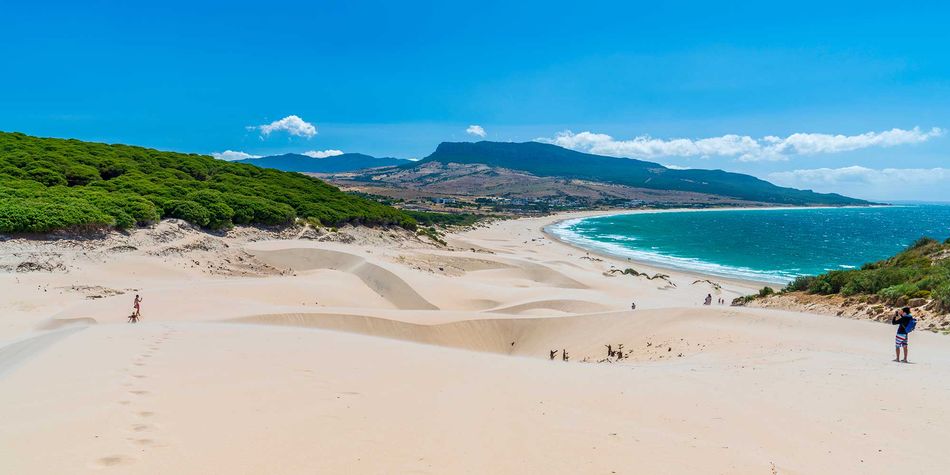
I stayed in a tiny guesthouse in Los Caños de Meca, among a few dozen whitewashed houses that cling to a great expanse of sand. Near here, at Bolonia, I also found a place that I was moved to name, against all the competition, as Spain’s best beach.
Spain’s other lesser-known coasts
Costa de Barcelona

Take the R1 Rodalies train north from Plaça de Catalunya in the centre of Barcelona and you’ll leave most tourists behind in less than 20 minutes.
Before you’ve even left the city, you could stop for gambas al ajillo (prawns in garlic) at one of the chiringuitos – beach bars – in the suburb of Montgat, beneath the shade of a scrubby hill that dominates this part of Barcelona.
Stay on the train for an hour and you’ll pass hidden coves and arrive at sleepy fishing villages, such as Sant Pol de Mar. These are popular with locals – especially at weekends – but not yet with overseas tourists.
Costa Dorada

South of Barcelona on the ‘Golden Coast’ there are well-known resorts such as Salou and Cambrils but also plenty of places that are just as appealing, without the crowds.
Tarragona, with its Roman amphitheatre and atmospheric old town, makes a great alternative to Barcelona itself, while fishing villages such as L'Ametlla de Mar preserve their old fashioned charm.
Costa del Azahar

One reason why the ‘orange blossom coast’, north of Valencia, hasn’t become popular – despite the beautiful name – is that it doesn’t receive anything like the number of tourist flights as Barcelona further north and Alicante in the south.
However, there are now a few direct flights from London and Manchester to Castellon airport, in the north of the Valencian region. From there it’s a half-hour drive to the medieval fortress town of Peniscola, with its twin beaches and rocky coves.
Costa Cálida

The province of Murcia, south of Alicante, receives fewer tourists than any other part of Spain’s Mediterranean coast, despite some spectacular beaches.
Most tourists that do find it end up on the concrete strip of La Manga. Just a short drive from Murcia airport, though, is Calblanque National Park, where no construction has been permitted on the miles of golden sands.
Costa de Almería

The best way to get away from mass tourism is to walk to one of the province of Almería’s many beaches that are completely inaccessible by car.
Fly to the much-overlooked city of Almería, with its own mighty fortress and Andalusian spirit. Then use small, pretty towns like San Jose or Agua Amarga as a base for hiking along the cliffs and sand dunes of the Cabo de Gata Natural Park.
Costa Tropical

The beaches south of Granada are much quieter than those on the Costa del Sol further west.
Even a more touristy town, such as Almuñécar, still has an authentic Spanish feel, with its winding alleyways and tradition of sunset family strolls along the palm-lined promenade.
A short drive from Motril, the region's biggest town, is the rocky beach of La Rijana, where clear waters lap against the limestone cliffs.