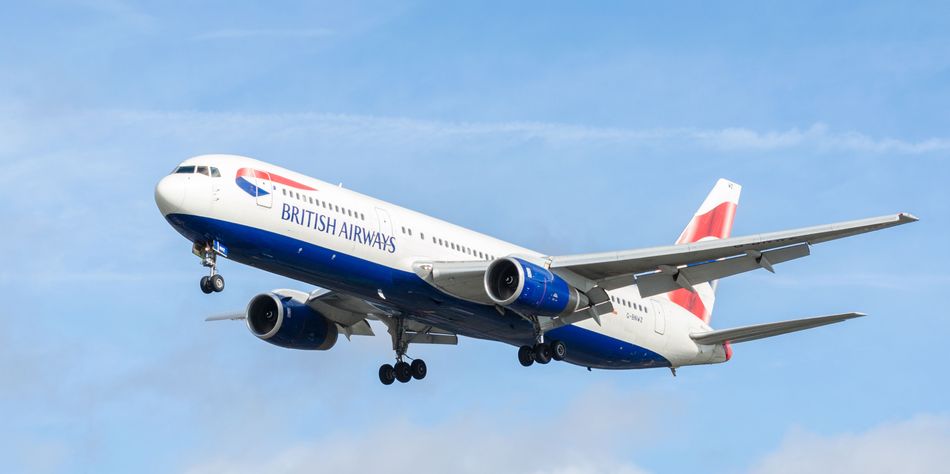
Erica: British Airways is the UK’s flag carrier. But does it deserve to be?
[BED STARTS]
Hi, I’m Erica McKoy and welcome to Which? Shorts – your free weekly insight into Which? magazine, as well as our Money, Tech, Travel and Gardening titles too.
Today I’m bringing you a piece that our travel expert Trevor Baker wrote for the October/November issue of Which? Travel, all about British Airways.
As the UK’s national flag carrier, BA’s status naturally gets a lift, but we’re calling into question whether British Airways should be the UK’s flag carrier, and asking if Virgin Atlantic should take over.
Here, Trevor rounds up our thoughts, backed up by audience research that shows how different customers think BA and Virgin are.
Here’s Trevor’s piece, adapted for the podcast, this week read by myself, Erica McKoy.
[BED ENDS]
—
Erica: If you fly with British Airways to New York, Canada or the Caribbean, you could end up squeezing into a seat that’s less than 17 inches wide. Go with easyJet or Ryanair and you’ll get more space on a summer holiday to Benidorm.
That’s because, on certain routes, BA uses a Boeing triple seven two hundred aeroplane that, when it was introduced in the 1990s, typically had eight seats in every row. Most airlines decided in the 2000s that they could squeeze in nine seats, but in 2018 BA went one better. It put in 10.
During the same period, BA scrapped free meals on short-haul, scaled back the choice of free snacks and drinks on long-haul, and replaced comfortable blankets and headphones with flimsier versions than its luxurious rivals. In other words, in our view, it did everything it could to turn into an economy airline. We’ve been pointing out for years that none of this is the behaviour of a ‘national flag carrier’.
Its only real long-haul competitor from the UK is Virgin Atlantic. Virgin doesn’t have any flights with seats that are less than 17 inches wide. Its afternoon tea of warm scones, clotted cream and finger sandwiches is quintessentially British – and miles better than BA’s cold snack box.
It has a modern fleet, averaging around seven to eight years old, compared with around 13 years for BA. Virgin also outperforms BA on almost every metric in our passenger surveys for economy class, business class and even airport lounges. So should we decide, as a country, that Virgin gets to wave the red, white and blue – instead of BA?
Well, not so fast. Because there are arguments in favour of British Airways – well, one at least. It’s much bigger. BA flies to around 80 countries; Virgin Atlantic just 15. BA also flies from 12 regional UK airports, while Virgin only has direct flights from Manchester and London.
You might think BA is cheaper, too. But for all its enthusiastic adoption of low-cost trappings, the fares aren’t always that low. When we compared routes to New York, Cape Town and Delhi, sometimes BA was cheaper, sometimes Virgin. There was little evidence that choosing what seems to be cheaper fabric for its blankets or flimsier headphone cables has helped BA cut fares.
Data from the surveys we’ve done in the past year or two also suggests BA still has a way to go to convince passengers that its service represents good value for money. Virgin was rated better than BA for value for money in both business and economy class.
In our annual economy class survey, Virgin does better than BA on the star ratings for booking process, boarding, food and drink, the cabin environment, value for money and the overall customer score for long-haul economy flights.
So what does BA actually beat Virgin on?
According to our annual survey, absolutely nothing. Its customer score of 72% is respectable for long-haul economy, but only customer service is above three stars. We think it could and should do better.
BA’s privileged position as the dominant airline at Heathrow helps it to be hugely profitable. It operates more slots at lucrative Heathrow than all of the rest of the airlines at the airport combined. In 2019, airline analysts OAG dubbed BA’s Heathrow to JFK flights ‘the world’s first billion-dollar route’. But have enough of those profits been invested in matching the standards of its rivals?
The average fleet age of BA is skewed upwards by the fact that it still has Boeing 777s that bumped off the production line when John Major was Prime Minister. Since the pandemic, it has been adding newer planes, but it won’t phase out those that are over 25 years old until 2030.
Perhaps the biggest difference between the two carriers is that Virgin Atlantic is trying to do one thing well: provide comfortable, luxurious long-haul flights. BA is competing with easyJet on short-haul hops from Gatwick to Spain, the big Middle East airlines on journeys to Dubai and beyond, as well as Virgin in the west.
And if you are going west, be aware that BA and Virgin will both happily flog you a ticket on their US partner airlines, American and Delta. These are rated even lower in surveys, and on inbound trips you’ll lose most consumer protections if your flight is delayed or cancelled.
What about business class?
It would be easy to think that, because business class is so prohibitively expensive, it must be a wonderful experience on every airline. Our survey suggests this is false.
We asked 855 lucky people who flew business class about their experience. Big
Asian and Middle East airlines Singapore Air, Emirates and Qatar were the best, with customer scores all above 83%. Virgin Atlantic got a highly respectable 77%.
British Airways was in a disappointing class of its own, down at the bottom on 61%. This is not just because it’s dragged down by the short-haul Club Europe – business class where you sit in a standard row, but with the middle seat removed.
We found that, even on long-haul, BA’s scores couldn’t compete with Virgin, let alone its eastern rivals. BA charging business class customers an extra fee to pick a seat is a perpetual complaint.
While no carrier got more than three stars for value for money, BA stood out with its mediocre score of just two stars.
Business class travel is not just about the experience in the air but also how you’re looked after at the airport. BA’s business class lounges – visited by the most survey respondents – were, at best, fine. But with a customer score of 63%, it was far below the 84% of Virgin. BA’s three stars across the board was equally mediocre.
‘Compared to Virgin Atlantic at Heathrow,’ one passenger told us, ‘BA was poor and very ordinary.’ In contrast, we didn’t have a single negative comment about Virgin’s business lounges.
When it comes to points schemes, neither airline has treated its loyal customers well in recent years. Both have devalued their air miles schemes by requiring you to spend more to earn ‘free’ flights. Which scheme is better value is down to where and when you fly.
Virgin essentially uses dynamic pricing, which means you can buy any seat on any route with points, but it is often very expensive. You need so many points for peak flights that it’s almost unfeasible.
BA only releases a small number of seats that can be booked with Avios on each flight. This limited availability makes it very hard to book popular destinations like Tokyo or Sydney. However, it uses a fixed number of points for destinations based on distance. While there is a peak and off-peak difference, BA tends to be cheaper if you want to fly in peak periods.
Ultimately, it comes down to where you fly. Virgin’s scheme is only really useful if you plan to go to the US a lot, whereas BA offers 200 routes you can spend points on, including European destinations.
So how did British Airways respond?
It told us that it has an ‘extensive global network, flying almost 300 aircraft to more than 200 destinations around the world’.
It says it flies up to nine times a day on its flagship route to New York and operates more than 700 flights a day across an extensive short-haul and long-haul network, offering choice and value.
It went on to say that it’s invested in a number of areas for its customers, and that while there is always more to do, it’s proud of the progress it’s made.
—