The shopping sites that are misleading customers

Erica is a senior presenter and producer who has spent more than fifteen years crafting stories across for major international broadcasters. At Which? she works across our award-winning audio and video content.

Online fashion boutiques claiming to be independent UK family businesses are popping up all over social media, but are they actually legitimate?
In this episode, Erica McKoy sits down with Which? retail expert and senior researcher Hannah Walsh to discuss her investigation into bogus boutiques. Hannah reveals how these misleading websites sell cheap items for a premium price under the guise of being an independent business.
We also chat about the clever tactics used to lure shoppers in, from fake countdown clocks to convincing AI-generated family sob stories. Plus, Hannah shares advice on how to use tools such as reverse image search and exactly what to do with your bank if you’ve been caught out.
Erica McKoy: In recent years, you might have seen more family businesses pop up. But are they all legitimate? On today's episode, I'll be chatting to Hannah Walsh about her investigation into bogus boutiques.
Hello, it's Erica in the Which? Studio. And today, I'm joined by Hannah Walsh, one of our retail experts and senior researchers and writers. Hi.
Hannah Walsh: Hi.
Erica McKoy: We're here to talk about a piece that you included in last month's magazine – Bogus Boutiques. Tell us a bit about what got this investigation started and also, I'm curious to find out about the journey. But let's talk about how this started for you.
Hannah Walsh: Sure. So, this was actually an idea that came from a conversation with my mother-in-law, who had placed an order after seeing a Facebook advert. She was going away on holiday, she'd seen an advert for some nice linen blouses and she thought it's going to be quite hot, so that would be perfect, they're the exact style I'm looking for.
She clicked through the advert, she'd ordered these blouses from this site that she was actually really pleased to see was a small business based in the UK, run by two sisters who were trying to follow a lifelong dream of opening a clothing boutique and they were struggling. So, she was actually really pleased to support them.
She placed her order and then quickly found out, when she got the tracking information, that the items were actually coming from China directly.
Erica McKoy: So, not a UK business.
Hannah Walsh: Not UK-based, no. They were coming from China and the wait for them was, I think, four weeks.
Erica McKoy: And her holiday? I'm like, what about her holiday? Her outfit?
Hannah Walsh: I think they did arrive just in time for her holiday, but it didn't matter because they were not as described at all.
Erica McKoy: So now I'm thinking, she probably had alarm bells ringing – it's not from a UK business, it's coming from China. Is it a family-owned business? I'm guessing she started thinking as well.
Hannah Walsh: Yes, and I think she actually then went onto Trustpilot and started to look at the reviews and found there were a lot of other people who had also fallen prey to Sylvia and Grace, who were the two sisters, who we think probably don't exist. There were lots of people saying their items had come directly from China, they were of a very poor quality, they didn't match the images, they just weren't as described or fit for purpose.
She tried to cancel her order, but they said that they couldn't, the shipment was in progress and she'd have to apply for a refund once they arrived. Yes.
Erica McKoy: And what's that refund process like? Is it a quick and easy one? Is it as simple as going down to the post office?
Hannah Walsh: Certainly isn't. No, it's certainly not. Well, maybe it's quick, but it's very expensive. So, what Sylvia and Grace didn't have on their website was that you'd have to return your items to China, so at your own expense, of course.
Initially, they offered her a refund, a partial refund, and she didn't have to return the items. So they said, "If we give you 20% back, you can keep these shoddy items, don't have to return them to us, but we'll keep 80% of your money."
She declined that, they went up to, I think, 50%, declined that, 80%, declined that, and eventually, she said, "Look, just give me the address, I want to send these back to you," believing that they were going to give her a refund.
So she went down to the post office and £26.99, I think, it cost her to send them back to China.
Erica McKoy: I was not expecting that. £26.99?
Hannah Walsh: Yes, so she'd already spent 100 and – I think it was £120 on these four – she'd ordered four tops actually, in the end, from Sylvia and Grace. So she'd spent 120 quid doing that, plus the £26.99 to send them back to China. It's a steep learning curve, isn't it?
Erica McKoy: Yeah. Oh my goodness, I wasn't expecting the £26.99, £27. And we've all seen it online, the expectation versus reality pictures, where someone might buy something online and then, when it arrives, it's just not what they expected. But this feels a little bit – I guess it feels a bit different in some ways.
Hannah Walsh: I think it is the same, actually. I have some of the items here that you can have a look at. Yeah, so this is the first one that I have is one of the items that Heather actually ordered. So, this was supposed to be a handmade or UK-made linen blouse that she'd ordered. It's just a smock, really. It's not – you can see where the stitching is coming out. It's not finished properly. It's definitely not linen.
Erica McKoy: Well, that's also – I can see, okay, so I can see there's thread, there's thread just hanging out, and the stitches are – yeah, it's like, obviously quite cheaply made and done quite fast.
Hannah Walsh: It's got a slit on either side of the – on the sides, and I think they're different lengths as well. So, it's even that – I'm sure one is longer than the other, I haven't measured them, but they look – they look uneven to me. Oh gosh.
Erica McKoy: And it's all just – it kind of feels – well, it's not linen. It feels like cotton or something.
Hannah Walsh: Like a very cheap muslin sack, really, is what it is, with some buttons on.
Erica McKoy: Oh, poor Heather. So, what's kind of gone on here?
Hannah Walsh: What was happening here is that Sylvia and Grace exists as a website, but they don't hold any inventory themselves. They are using what's called a drop-shipping fulfilment method.
Erica McKoy: Explain what that is.
Hannah Walsh: So, there may be somebody in the UK who works for Sylvia and Grace, but they don't hold any inventory themselves. They have never seen this item that they're selling. They've never been hands-on with it. So what happens is, when you place an order with them, they send the order to their fulfilment partner in China – usually in China – who then ships the order to you.
The companies that you're buying from like Sylvia and Grace, and the ones in the investigation, have never seen the goods, they have no idea what quality they are. They're just acting as a middleman between fulfilment partners in China and UK consumers.
Erica McKoy: And that's a normal thing. Drop-shipping is something that happens in the UK and around the world.
Hannah Walsh: Yeah, there's some very well-known companies that started as drop-shipping only, like Wayfair, for example. They – they're not just drop-shipping now, but that is still part of their fulfilment model. And if it's legitimate and you're working with trusted suppliers, then I think it's something that can work. But in this instance, obviously, the suppliers are not fulfilling what has been promised.
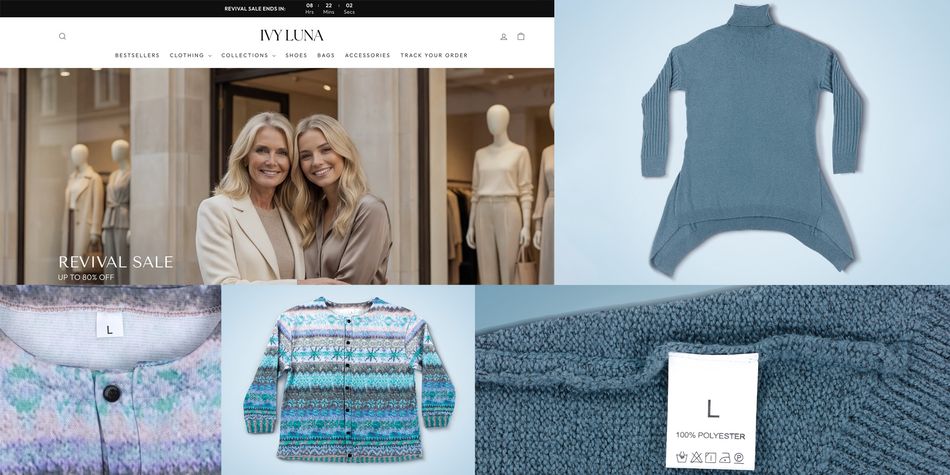
So using reverse image searching, I looked on sites where I was already fairly sure that they were using this model of drop-shipping and AI descriptions and AI images, and I searched for those same products across the internet. So even when somebody said they're a UK-based boutique, they're stocking unique items, I was able to find those items on marketplaces like AliExpress, Temu, Amazon, etc.
Erica McKoy: Remind us as well what reverse image search is, because it is something you can do at home if you wanted to.
Hannah Walsh: Yeah, it's a great tool to – to check the legitimacy of a product and if it's definitely going to be handmade and from the UK. So, you just right-click on an image. It might give you the option to search the whole page and then you can crop and select which section you want to search, and then it comes up with a list of products that match the image that you're looking at.
So yeah, like I said, we found them – I found them on marketplaces, but also on other boutiques claiming to be UK-based, although it's not just the UK, there were Australian boutiques, Spanish boutiques, it's really worldwide, I think.
Erica McKoy: So, it's not quite the family – family setup business that Heather expected, or anyone expected.
Hannah Walsh: No, and the products were often a lot cheaper when we were seeing them on Temu, etc., even though they're the same item. The boutique shops were listing them for, I think, four times the price in some occasions.
Erica McKoy: Wow. AI – you mentioned AI. AI is kind of a big part of the story. I feel like I've – I've definitely seen the ads where it's a mother and daughter or two sisters or, you know, just a family business, and often, what I've noticed they'll do, is they'll say, "We're closing down, the business has had to close down because we can't run it anymore." Can you talk to me a bit about this AI aspect?
Hannah Walsh: Yeah, so I think even in the last year or so, the shops have become a lot more sophisticated in their use of AI. It's a lot more convincing than it was. Gone are the days of kind of six-fingered people holding closing-down sale signs, it's not that anymore, it's convincing-looking people standing outside a shop saying, "We're closing down, we've put our heart and soul into this, please support us, please help us."
I saw examples where it was a mother and daughter, where it was two friends, a family-run business closing down after 10 years, all sorts of fake stories. Another shop I saw was called York Marlo. And for their imagery, they used a picture of a shop within the city walls in York, with the branding York Marlo – or Marlo York, sorry, on it. So they actually put it in a place where there are shops, made it look convincing, so people would believe it and think, yeah, if next time they're in York, they can visit Marlo York, but it doesn't exist.
Erica McKoy: Yeah, and it's all about trying to look a bit more legitimate, isn't it? Exactly, yeah. What other tactics are they using when they are trying to lure you into their shops?
Hannah Walsh: So we see the classic pressure-selling tactics – countdown clocks, how many products have been sold. So I think with Ivy Luna, they've had a revival sale on since I started doing this investigation months ago. Every day, the clock resets. So every day you could go onto that website and it may say "12 hours left of our revival sale," next day you'll go on, it'll be like "13 hours left of our revival sale," just resets every day. But makes you feel like you are going to miss out on the sale, exactly.
Reviews as well, a lot of the sites would have a kind of snippet of a review saying how great it was and saying things like – claiming things like 12,500 five-star reviews, etc.
Erica McKoy: Are they real?
Hannah Walsh: No, you can't find them. If you try and click through, doesn't take you anywhere. On a legitimate site, if they have reviews like Feefo or Trustpilot reviews, you can often click the link and it will take you to the full listing. These just don't exist, they're just on the site, they're nowhere else to be found.
Erica McKoy: But it's all adding to this thing to make it look legitimate.
Hannah Walsh: Exactly, yeah.
Erica McKoy: How are people finding these shops? I know you mentioned social media and Heather finding it on social media whilst she was browsing. Are there any other ways? Is it mainly just social media?
Hannah Walsh: I think it's mainly social media. Facebook ads, I even had one of the sites advertised to me on Pinterest as well, ads on news websites they may be in. But yes, majority of people seem to be coming across them via social media. We've seen a lot of – I found a lot of interactions on social media from people saying, "I got tricked looking on Facebook," for example.
Erica McKoy: All of this seems – I want to use the word scam – all of this feels like a scam, a bit fraudulent.
Hannah Walsh: I did actually contact the companies that I ordered from. Some of them had disappeared, the websites had been taken down or just been closed. But actually, Ivy Luna and Hudson Grace, which has now rebranded, actually – which is another tactic we see quite a lot, they kind of – it's like moving sand, shifting sands, so that you can't find them on review sites. They did actually respond and say that they are legitimate businesses, that they are UK-based.
They didn't respond to our questions around the use of AI images or AI blurb about the site, but they claimed to be legitimate businesses. They're providing you with a product, which is what makes them slightly different to something like a purchase scam. So with a purchase scam, you would order from a site and then you receive nothing. In this case, you are receiving a product, it's just not the product that you were expecting to receive.
Erica McKoy: You might order something that's 100% linen and you get –
Hannah Walsh: I've got some others that I can show you, there are some real doozies here. Show me, Hannah. So, this is a piece of knitwear. You have a look at that one.
Erica McKoy: Oh my gosh. It's not.
Hannah Walsh: No, it's printed knitting pattern on a polyester cardigan.
Erica McKoy: Oh no. Imagine if this arrived. I know. And it's just not going to do – it's not going to do what a piece of knitwear is going to do.
Hannah Walsh: No, feels horrid. Put it on, it's like – make sure the hairs stand up because it's so static.
Erica McKoy: I can't believe that.
Hannah Walsh: I've also got a linen shirt here which, as you can see, is not linen. It's not moving like linen. No, it's actually got spandex in, which I don't think you often find in a shirt.
Erica McKoy: That's really wild. I can't – I actually can't believe that. I'm so happy you brought this in but I just can't believe that this is okay. My next question is, there's sort of Online Safety Acts and stuff like that, does that not fall under this? Is there no protection for people?
Hannah Walsh: So, the Online Safety Act would be targeting the fraudulent advertising that people are seeing on social media, for example. So, as we know, or as I suspect, this is where most people are coming across these sites. So, that is really what would be tackling that element – so how people are coming to these sites in the first place. The false claims about sales, closing down, time-limited offers, etc.
Erica McKoy: But the fact that you get a product kind of means that actually, they are following through, I guess, with what they said they were going to do.
Hannah Walsh: Yeah, they've just misled you, it's what we do if we kind of come across one of these ads, or if we know family members who have seen an advert and they're like, "Oh, buy myself a new t-shirt or jumper," whatever, jumper. Yes, I know. This is really crazy. What do we do? What should we be looking out for?
Hannah Walsh: So, look out for those sob stories. I mean, not to be a cynic, but do apply a slightly cynical eye to sob stories that you read on social media in adverts.
You can also – you can actually harness AI yourself. So I, for a few of the sites, I put the URL of the sites – so the web address – into an AI – like for ChatGPT, for example, and asked them to look for evidence of AI use on the site. And actually, AI is quite good at spotting itself in most cases. So, it was flagging signs that the images were created using AI, the images of both the clothing and the people behind the stories, also flagging where a site claimed to have existed for 10 years, but actually, in the code of the site, you can see it's only – it was only made three months ago.
Erica McKoy: Because that's also another thing, it's like, you know, often these businesses are saying, "We've been around for 50 years, this is a family-run business," but actually they –
Hannah Walsh: It just provides another layer of legitimacy, because you trust a business that has been – that is well-founded, I suppose, but actually they – they haven't. And in some cases, they've changed their name as well, which – which AI did flag a couple of times to me. So, that is also a sure sign that they're trying to avoid a trail, to be found, yeah.
Erica McKoy: Are there any other things that we can look out for? So, we can use AI to help us. Is there anything else?
Hannah Walsh: Don't feel pressured, ever, when you're shopping – with these sites or anywhere else. We – in other investigations, I've found that sales prices, you can often find them again at the same price or lower. So, don't feel pressurized by things like countdown clocks, sales claims, how many items have been bought. You know, just don't – apply a bit of logic to it before you click buy.
You can also look elsewhere for reviews of the shop. So say if the – for Ivy Luna, for example, where they seem to have kept their name for a little while, we can see on Trustpilot that there are plenty of negative reviews of people that have had a bad experience, especially when it comes to returning the items. Not just Ivy Luna, for all of the shops that we could find reviews for elsewhere, that was the case. So –
Erica McKoy: Do a bit of research.
Hannah Walsh: Exactly.
Erica McKoy: Take your time.
Hannah Walsh: Yeah.
Erica McKoy: There's no pressure to buy immediately.
Hannah Walsh: Yeah, exactly.
Erica McKoy: Gosh, I feel like there's so many people in my life that I would – there's a couple of people who I'm like, yeah, maybe you need to double-check, don't kind of – because I think people buy into the story and they just want to support an independent business, especially when the world is as it is. Very easy. You want to support people.
Hannah Walsh: Yeah, and they – I don't know how, but it seems to be always items that you – it's exactly what you want, actually. Exactly what I've been looking for, I've not found it anywhere else. And then you click through. Perfect, it's on sale. What a treat, actually. Yeah, it's very easy to do.
Erica McKoy: Okay, Hannah, and what do we do if – if someone has been caught out? They've – they've, you know, sent their money to this company and it's – they've found out actually it's just not legitimate.
Hannah Walsh: Yeah, ignore requests for returning items for partial refunds. Don't go down that route with the retailer. What you should do is contact your bank. So, make a record of any transactions, anything that has happened, any correspondence you've had with the shop where they've asked you to send items back to China at your own cost, where they've offered partial refunds – contact your bank. That is the most reliable way to get a refund when you've fallen victim to – to something like this, yeah.
Erica McKoy: Okay. Hannah, stressed out. We're stressed out. But thank you so much for joining me today.
Hannah Walsh: Thank you.
Erica McKoy: Thanks for listening to this podcast from Which?, the UK's consumer champion. You can find plenty more advice about what we discussed today in the show notes. There, you'll also find a link to become a Which? member for 50% off the usual price, an offer exclusively available to you, our podcast listeners.
Joining Which? will not only give you access to our product reviews, our app, one-to-one personalised buying advice, and every issue of Which? magazine across the year, but you'll also be helping us make life simpler, fairer, and safer for everyone.
Don't forget to hit subscribe wherever you're listening. That way, you'll be notified whenever we release a new episode of Which? Money, Which? Shorts, or any other podcast we make for you. And if you want to get in touch with us, then follow us on social media @WhichUK or drop us an email to podcast@which.co.uk. See you next time.
Be a smarter consumer
free newsletter
Choose well, buy better and save money with the Weekly Scoop.
Unsubscribe whenever you want. Your data will be processed in accordance with our Privacy notice.
More podcasts from Which?
The Which? podcast showcases the best content from across our website and magazine.
Which? Money episodes, released on Fridays, give advice to help you get on top of your bills and tackle the issues hitting your pocket, from spiralling energy costs to your weekly food shop.
The Which? Shorts podcasts offer you a free insight into some of our favourite articles from our suite of magazines.
Plus, keep an eye out for bonus episodes that tackle important issues, from motoring to tech, health and wellbeing to travel.
How to listen to the Which? podcast
We're always releasing new episodes, and the podcast is available wherever you usually listen to podcasts.
Subscribe using one of the links below or click this link on your mobile to find us in your favourite podcast app.
As part of your subscription, Which? members also get access to exclusive podcasts.
- Listen to member-exclusive podcasts on our website
- Listen on the go by downloading our app on Google Play
- Listen on the go by downloading our app from the App Store
If you're not already a member, podcast listeners can get 50% off the first year of an annual membership.