Where to next?
Discover inspiring destinations, recommended by our in-house travel experts. Know the best places to go, who to book with and how to pay less.
Join Which? Travel
One of the UK's most trusted travel journalists, our award-winning travel editor spent a decade writing guidebooks around the world. Since 2016, he has been recommending where to go, who to go with and championing passenger and holiday rights for Which?

There isn’t another museum in the world that could bring me close to tears over wallpaper.
I’m standing inside the hallway of a dentist’s office and residence from 1913. Upstairs, a costumed staff member talks visitors through the frightening prospect of the treadle-operated drill, and why patients booked morning appointments to avoid seeing the dentist when his legs had run out of puff.
Down the corridor, visitors in the scullery watch an aproned staff member roll dough and poke a coal-fired cast-iron range, preparing rock cakes. The entire building is a treasure trove of Edwardian items, fixtures and fittings – including the wallpaper.
It’s a geometric floral pattern, but what’s special is how it is embossed, distinctly raised from the wall. More extraordinary still, it’s the same type of wallpaper that lined my nana’s staircase. Back then, I thought little of it – a curiosity of an old person’s home. But now I realise I have never seen this wallpaper in any other house, nor have I thought about it in 30 years.
As I run my fingers along the petals, I can recall every bump of the wooden bannisters that I gripped tightly in the dark as a scared young child. Fifteen steps to reach the light in the bathroom. The dusty Gran Canaria jug at the staircase’s quarter landing. Did it have palm trees on it?
Happiest of all, I can picture the silhouette of my nana – her short perm and wavy dress to the ankles – set against the moonlight, standing at the top of the stairs waiting to read me a story.
There is something joyous about these memories returning unexpectedly. I am here with my daughter, and this wallpaper lets me share stories, however small, from her family that would otherwise have been forgotten.
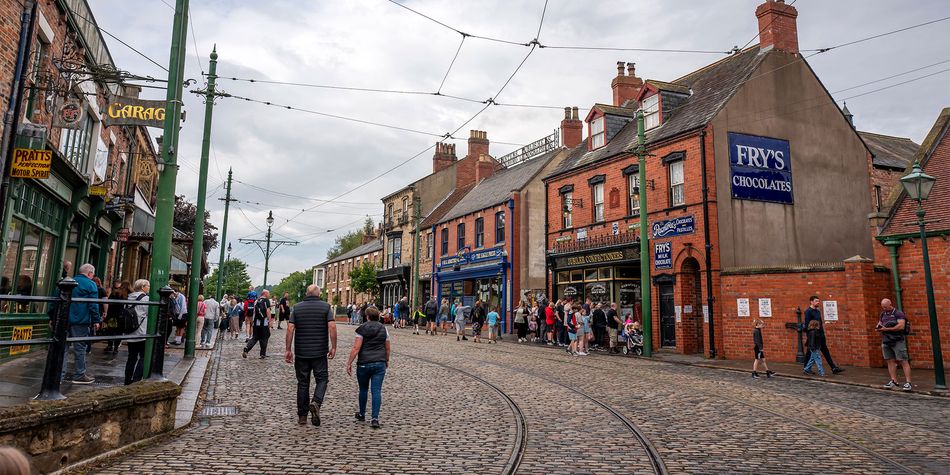
At the Beamish Living Museum of the North, it’s memories like this that give meaning to what you see. And is almost certainly why it jointly topped the table of our survey of the best museums and art galleries in the UK.
Exploring the 350-acre site, and in each of the four distinct period areas (1900s town, 1950s town, pit village and colliery and the 1820s landscape at Pockerley), the words I hear most often are “I remember”.
This article first appeared in Which? Travel magazine. Unlike all other national travel magazines and newspaper travel sections, Which? Travel never accepts freebies. No free travel, no free accommodation, no free meals, no free anything. It lets us give you honest, unbiased recommendations you can trust.
Discover inspiring destinations, recommended by our in-house travel experts. Know the best places to go, who to book with and how to pay less.
Join Which? Travel
In the grocery section of the Annfield Plain Co-op store in the 1900s town, I watch two elderly sisters flip the lid on the mahogany biscuit display and reminisce about their mother letting them select individual Lincoln and Garibaldi biscuits as a Friday treat. A sort of Edwardian pick and mix. Their names must remain anonymous because memories turn to accusations of an occasional Garibaldi being swiped.
Over at the Pit Village, inside a recreated miner’s cottage, a visitor watches one of the volunteers progging a rag rug. She explains to her son how she often sat on her grandmother’s knee to fold and braid the long fabric strips of worn coats to make these rugs. They would drink tea, sing and boil water on the coal fire for when her grandfather came home from the pit.
These are not stories about the past. They are people’s past.
Helen Barker, the executive director of collections and programmes, tells me that ‘what’s most incredible about the Beamish collection is not that we have 2.5m items, but that most of them were donated by local people’. She continues: ‘This deep community connection ensures we tell the right stories.’
Of course, Beamish works perfectly well as a conventional museum, too. I read transatlantic crossing pamphlets and shipping-line correspondence in the Emigration and Shipping Agents Office, watch pear drops being made in the sweet shop and handle carbolic soap in the pharmacy.
But it’s the people who bring these objects and buildings to life. Although staff and volunteers are costumed, the museum titles them ‘engagers’ rather than re-enactors. ‘They are there to answer questions and give facts, but also just to engage people with the stories of a place,’ Helen explains.
Helen and I meet outside the welfare hall of the 1950s Town. Beamish’s newest area runs along a high street that includes a chippy and a hairdresser, an electrical store and record shop, allotments, a bowling green and more.
The centrepiece is the Grand cinema. This is the real Grand cinema from up the road in Ryhope, saved by Beamish from its later life as a derelict garage and lovingly rebuilt in the museum. Helen talks about the crucial role of Bill Mather – a former trainee projectionist and manager of the Grand. ‘Over many, many hours he helped us get as many of the small details right as possible,’ she says.
The cinema is magnificent. Under Art Deco sunburst plaster reliefs and stained glass windows of sailing ships, my daughter and I watch a Pathé newsreel of the Queen’s coronation. A replica of Bill’s original jacket now hangs in the projection room. It is often the small details that catch people most powerfully.

Like the pair of former hairdressers who pop their heads into the salon on the high street, as I wait for my daughter to get her hair twisted into a 1950s bow (£5) by Michelle, a more recent retiree from the trade. While Michelle squirts a mushroom cloud of hairspray, the retired hairdressers pick up piles of period bobby pins, remembering the sore fingers they endured from bending hundreds each day.
One of the hairdressers talks about how her mother often made her get the bow hairstyle, which she thought old-fashioned at the time. But with a pang of nostalgia, she books herself in with Michelle to have it tied.

Even after two full days of exploring, I haven’t seen everything. In the final hour, I rush to a pair of reconstructed council houses from the 1950s in the hope I’ll unlock memories from my childhood on an estate.
I’d completely forgotten about the miniature ceramic jugs many people, including my family, used to collect as holiday souvenirs. They featured a heraldic shield or – better – a local landmark and stood just 5 or 6cm tall. As I peer at the dozen displayed on the wall here, I can remember begging my mother to buy me one in a Lowestoft souvenir shop; and Torquay; and Paignton. They adorned a shelf in my room until teenage embarrassment relegated them to the attic.
I ask one of the engagers in the room about the photos on the wall above them. When Beamish was building the 1950s town, they invited people across the North East to enter a competition to have a replica of their own council house built at the museum. The winning home belonged to Esther Gibbon. The picture on the wall is her and her husband Eli’s wedding photo.
Esther died before Beamish opened the replica, but her daughters Brenda and Linda stepped in to plan every detail of the house, from the books in the sisters’ bedroom to the exact placement of their father’s lighter and ashtray. The curtains hanging in the living room were handwoven by Esther and donated by her daughters. Suddenly, it doesn’t feel like a reconstruction but someone’s home.
Most extraordinary of all is that Brenda and Linda now, most weeks, volunteer in the house. They walk visitors through the replica of where their mother spent 67 years of her life.
The past here isn’t necessarily somebody else’s story, but your own. Sometimes it is a bobby pin, or a Garibaldi biscuit. Sometimes it is a souvenir jug or bumpy wallpaper you haven’t thought about since you were a child. And sometimes it is simply having someone beside you to tell

We stayed overnight at the museum (we paid for this stay, and booked anonymously) at one of a pair of self-catered cottages restored by the museum and bookable through Airbnb. Drovers Rest is an original farm building with furniture, like the grandfather clock, chosen by the museum team. There are also modern comforts including a shower, TV and kitchen. The views over horses, cows and puffing steam trains are unchanged in 200 years. You’ll only have the sounds of the gaggling geese and grunting pigs from the farmyard behind for company, once the park closes.

There are more than 60 buildings and attractions across four distinct areas – the 1900s town, 1950s town, pit village and colliery, and the 1820s landscape at Pockerley – so you won’t fit everything in one day. Instead, explore the section you’re most interested in. The 1900s town and 1950s town contain the most buildings and are right next to each other. Everything is included with your ticket, except a handful of experiences – like having your hair done in the 1950s town or getting a photo in 1900s-style costume