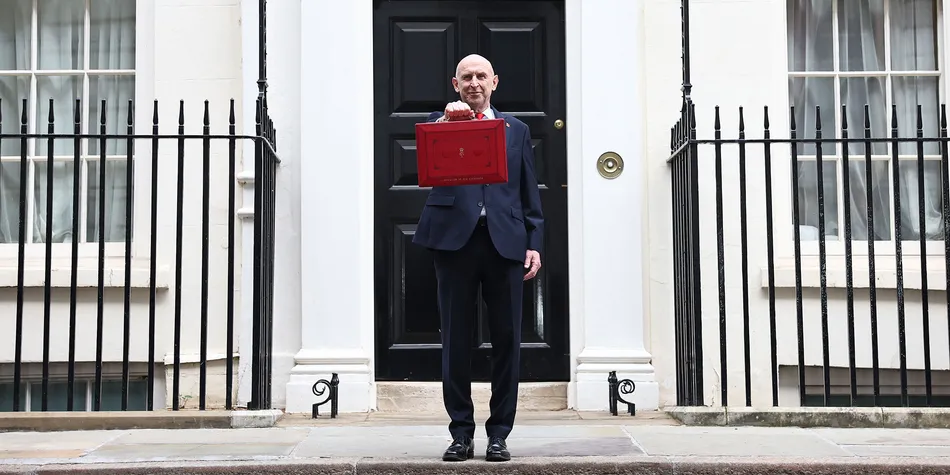
Will the Chancellor's Budget give people the 'breathing space' he spoke about?

James brings experience from the BBC and commercial radio to our award-winning video and audio team, where he produces our always-on podcasts and presents Which? Money, our weekly personal finance podcast.

Sam is the editor of Which? Money magazine and has spent over a decade writing about money topics in London and Sydney.

A £100 energy payment for 20 million households and a freeze on fuel duty extended to July are among the headlines we discuss from the Autumn Budget.
Chancellor John Healey's Autumn Budget is set to bring 'everyday fixes' to help the cost of living crisis. He started his speech by dedicating it to the ‘working people of Britain’. But what does that really mean?
In this episode, Which? Money editor Sam Richardson and AJ Bell's director of public policy, Tom Selby, join James Rowe to discuss the first Budget under Andy Burnham's premiership.
John Healey: This is a Labour budget for the worker, the sole trader, the parent at the school gate, the young person desperate to start their first job or start their first business. These are my choices: raising revenue from those who can afford to pay, no tax rises on wages or dividends, cutting taxes for millions of families and businesses.
James Rowe: That was John Healey today during his first budget speech as Chancellor. He couldn't have made it more clear that his announcements were aimed at giving households, as he put it, breathing space. So what will his policies look like in reality? Let's find out on this episode of Which? Money.
James Rowe: Hello, it's James in the Which? studio alongside Which? Money editor Sam Richardson. Sam, hello.
Sam Richardson: Good afternoon.
James Rowe: Hello, nice to see you. And from AJ Bell, their director of public policy, Tom Selby. Tom, hello.
Tom Selby: Hello.
James Rowe: Nice to have you both with us. We'll get into some of the big headlines in just a second, but for the two of you, how was the budget speech? Did you enjoy it? Was it a bit of a damp squib?
Tom Selby: Reasonably chaotic from my point of view, so I had my first broadcast appearance where I was having to talk about the budget while it was happening, which was challenging. So I've got a lot of extra respect for broadcasters who do that kind of thing.
I think a large chunk of it had been pre-briefed in the usual way. It was very much lots – as we've seen from the Prime Minister since he came into office – lots of little, tangible things that will make a difference to people. But in the round, it's kind of a holding-pattern budget, I think, before some more big decisions and big reforms come down the track, probably post-general election realistically.
James Rowe: Sam?
Sam Richardson: Yeah, a lot of mentions of breathing space. I gave up counting during the speech itself, but I saw 38 mentions in the budget document alone.
James Rowe: Yeah, you can see what their agenda is.
Should we start with probably the biggest announcement for most households up and down the country, is this £100 payment to a lot of households? Sam, what's the detail behind this?
Sam Richardson: Yes, so from January 2027, if you live in a property in council tax bands A to D, which are the lowest, you will get a £100 payment straight into your bank account to help with the costs of energy.
It's been predicted that the Ofgem price cap, which most will pay on a default deal, will go up by 16% in January – around £23 a month. So this £100 payment should really help people.
James Rowe: And especially at that time of year as well. If you are going to go onto a higher price cap, that £100 coming in in January, Tom, is going to be – it's going to be this breathing space for people, isn't it?
Tom Selby: Yeah, a huge help for lots of people, and various other energy measures announced as well. The extension of the VAT cut on energy bills and various other bits.
There's a very clear and understandable strategy from the government to focus on the cost of living, and focus specifically on the thing that is going to have the biggest impact on most people in the short term, which is rising energy prices.
Critics will say lots of people will still see their energy prices go up, but the reality for most people is that they'll go up by less than they otherwise would have done. In an economic environment where there's not a huge amount of money to go around and you have to focus on some quite direct interventions in specific areas, you can understand why this government at this moment in time has just gone really big on energy and said, actually, in the short period of time, we're going to make sure that people's bills don't go up by as much as Sam said they're going to go up potentially in January, I think it is.
James Rowe: And we know that energy bills is a top priority for a lot of the country. According to More in Common, the pollster, just last month 58% of Brits said bringing down energy bills was their top priority for the budget this week.
There was another big announcement as well, Sam, on energy bills, on gas standing charges. Can you try and explain what's going to go on here?
Sam Richardson: Yes, so when you pay your energy bill, part of that is connected to how much you use, so if you use less, you'll pay less. But part of that is a standing charge that everyone has to pay; it's not connected to usage at all. The government wants to get rid of the standing charge for gas, so your bill will be much more related to how much you're using.
I think we all got very excited about this earlier today, as Healey put it, it was a radical reform of energy, until I spotted it said in the budget document by the end of 2027. But then you, James, spotted the phrase "or as soon as possible after then" –
James Rowe: Yeah.
Sam Richardson: – which potentially means it could frankly be any time. It will be a helpful change, but not for a long time, and we've got some big energy price increases coming before then.
James Rowe: Yeah, and it looks like they want to adjust the standing charges on electricity bills as well, again at some point in the future. But these are tangible savings. So if you get this £100 payment from the government if you're in England in a council tax band A to D, you then might get around £50 savings on the removal of VAT from electricity bills, and maybe around £45 a year on the abolition of the gas standing charges. So it's £200 for working people. It's a big chunk of money, isn't it, Sam?
Sam Richardson: It is, it's really considerable. I would say to people, it is always worth cutting your usage; it will reduce your bills, even with all these other measures. That doesn't necessarily mean an incredibly expensive loft-insulation job. It could mean just running appliances on eco mode, looking at small draughts in your house. That sort of very small jobs will make a difference.
Also, do look, when you come to renew your energy deal if you're currently on a fixed deal, do shop around. It's not like it was a few years ago where there was basically no point shopping around and everything was at the price cap. You can get more competitive deals these days.
James Rowe: Yeah, and I know this is the Which? Money podcast, but we've got loads of useful advice around saving money on energy bills on the Which? website. We'll pop some useful links in the show notes for you.
But it wasn't just energy bills, there's plenty other announcements as well. Tom, can I come to you on the cash ISA allowance? Last year, during Rachel Reeves's second and final budget as it was last autumn, she announced a plan to reduce the amount you could save into a cash ISA from £20,000 to £12,000 for most people, I think under the age of 65, wasn't it? But that's been reversed, hasn't it, before it's even come in?
Tom Selby: Yes, a very clear U-turn by this government, and a positive one. Across the industry – both cash providers and retail investment providers like AJ Bell, for whom the cash ISA cut was supposed to benefit their customers because the aim was trying to get more people investing – everybody said that this was a dog's dinner. Everybody agreed that the aim of getting more people to invest where it's appropriate for them is a good aim, but the way that Rachel Reeves went about it was cack-handed; it was the wrong way to do it.
Obviously, a frustrating process in terms of two years of arguing against a reform which most people agree isn't going to work, the suggestion is it's going to go into place, and then it gets canned. But better to get rid of it now for John Healey, essentially his earliest opportunity, than to allow it to be introduced and massively overcomplicate what is already a complicated ISA system. They were planning to introduce a tax charge on cash interest in stocks and shares ISAs – really unwelcome – bans on transfers, tax charges on cash-like investments as well, so the whole thing was a bit of a complicated mess.
Going back to what the theme of this budget was, it was cost of living. One of the warnings that came from some of the lenders was that if you reduce the cash ISA allowance, then potentially they would have to increase mortgage rates because they've got less money coming in that they can lend out. Who knows how big an impact that would have had, but you can understand, given the clear focus on cost of living, why go ahead with a set of reforms which the scope of the industry hates, customers hate, and potentially are going to increase people's mortgage costs? It was a bit of a surprise when it was reported in the Financial Times this morning, but when you sit back and look at it, it was a bit of a no-brainer, I think.
James Rowe: And even though those reforms hadn't even come in yet – they were due to come in next year – had it actually worked? Were more people actually investing because of it?
Tom Selby: No, the opposite. The change was supposed to come in in April 2027. What we and others warned the Treasury about was: A, it was increasing complexity; B, there was no evidence it was actually going to result in more people investing. If anything, it hardens the border between saving in cash and investing for the long term, and for most people, they need to do a bit of both.
Fundamentally, in the short term, there was a scarcity value around cash ISAs. You've got a £20,000 cash ISA allowance until April next year when it's going to go away. In the short term, the aim was to get more people investing, but the incentive was for more people to go into cash either with their subscriptions this year or to transfer before there was a ban on transfers from stocks and shares ISAs to cash ISAs.
For many, many reasons, it wasn't a particularly sensible way about achieving that policy aim of getting more people to invest. Credit to the Chancellor, I think, for nipping it in the bud when he has done.
James Rowe: Sam, there was, though, a new announcement – John Healey's way of trying to encourage more people to start investing. What do we know about it so far?
Sam Richardson: Yes, I recall when Healey said this in the speech, he used the term "starter ISA". When I looked at the documents, it was presented as an incentive for new investors going into stocks and shares ISAs. Absolutely no more detail than that, other than they would work with industry to develop a new approach.
Tom, really interested to hear what you would like, what AJ Bell would like out of that. Just before that, I would say, every time they change ISA rules, it really puts people off, effectively.
Tom Selby: Yeah, agreed.
Sam Richardson: It makes investing seem incredibly complicated when we're trying to persuade people that actually it can be really quite simple. So I have really kind of mixed feelings on this. I don't know about you.
Tom Selby: Well, clearly we're interested in the idea and we'll engage with the Treasury, as one would expect that we would do, to understand exactly what they're trying to achieve.
One of the challenges that I would put to them is that they're slightly putting the cart before the horse here. Getting more people to invest, great; considering having an incentive for new investors, again, great. We all know that there's lots of people who don't invest who should be investing – the people who are holding too much cash, essentially. How do we get them to invest? Bring the industry around, because this is something where the vested interests of the industry, including AJ Bell, should work in your favour, because we all want more people investing as well.
Instead, in a similar-ish way to the cash ISA reforms, they've started from a, "Let's have a starter ISA". It may work, that may be the right solution, but it may not work. Complexity in financial services generally is unhelpful. Lots of people who are just starting out won't know what investing means, won't know what a fund is, won't know what an ISA is.
Adding an extra layer of complexity, albeit if there's an additional incentive it may get some more people in, I think is potentially challenging. We need to work through all that detail, which at the moment, as you say, Sam, is pretty thin on the ground at this stage.
James Rowe: They could just give us all £100 on top of the £100 for the energy bills, couldn't they? Say, "Here's £100, you've got to put that into a stocks and shares ISA."
Tom Selby: Maybe that's what they do. The starter ISA, we've been made to think it's a product, but it could just be that if you're aged under 30 or under 40 or whatever, your first £1,000 of subscriptions get a 25% bonus, and that could be it. That could be the starter ISA. That's something I think a lot of people could get on board with, because once you get people in and get people saving and investing, then actually you build up that habit.
On top of that, there's benefits for the individual in terms of building financial resilience, for the economy in terms of getting more money into capital markets. There's lots of reasons why that could be a good way to go about things. But clearly, if you're creating something that's an age-based allowance, possibly with a bonus attached to it, that is more complexity in the system. It is something that we need to work through with government to make sure that it will achieve the aim of getting more young people to invest.
Sam Richardson: Final point on this. We don't have a date for this incentive to come in; consultations and implementation can take ages. I would be slightly concerned about people saying, "Okay, I might get this incentive if I'm a first-time investor, so I'm not going to start investing now," given that markets can rise by – I think the FTSE was up 10% over 12 months. So maybe there's a bit of a concern there. If you have the money now and you're thinking of investing, you should probably just go for it.
Tom Selby: Yeah. Whenever I'm asked the question – often people will try and second-guess budgets, second-guess the impact of changes that are going to happen – deal with the tax regime and the rules as you see them today. The government said it's got an intention to introduce something called a starter ISA; we've just discussed it. None of us know what that is, none of us know when it's going to be introduced.
If investing feels right for you, if you've built up that cash buffer that you need for the short term, then, as you say, Sam, go for it. It's something that the government's going to need to think about, is what they don't want to do, as you say, is create a disincentive for people to do that now because they're waiting for something in the future.
Even things like defining what is a starter – is it an age-based thing? There'll be lots of 29-year-olds who are really experienced investors, and there's lots of 50-year-olds who aren't. Is it your first subscription to an ISA? Is it based on your age? How much bonus, if there's a bonus, do you get? Do you have to invest in a certain way? All of that stuff needs to be figured out reasonably sharpish because, as you say, you don't want people holding off making decisions that might be the right ones for them.
James Rowe: And Sam, I guess a lot of this is about diversification as well, isn't it? People with a lot of cash sitting there might think that's great, but equally, you might actually be able to grow your money further if you are investing.
Sam Richardson: Yeah, I feel we're going to get more onto this later, but if your money is in savings accounts or cash ISAs, it is being devalued by inflation, unless you're earning the absolute top interest rate possible. Effectively, investing is the only way to genuinely grow your money.
I would say to people, don't just leave loads of money in cash for years and years. Once you've sorted out your debts, you've sorted out your emergency funds, really look at investing. Loads and loads of useful advice on our website.
James Rowe: As ever. You said we were going to get onto something, and I think I'm going to get onto it now, because there is another tax rise on the cards – well, I say on the cards, it is coming – a tax on income made from savings, Sam. What do we know?
Sam Richardson: Yes, so when you earn interest on savings, you get a tax-free allowance of how much interest you can earn, which is £1,000 for basic-rate taxpayers or £500 for higher-rate taxpayers; additional-rate taxpayers don't get a tax-free personal savings allowance.
Above that, you used to pay your rate of income tax, so say 20% for basic-rate taxpayers. Then it was announced that that would rise by two percentage points in April next year. However, we now know it's going to rise by four percentage points.
Just to spell out the new rates, if you're a basic-rate taxpayer, you'd be paying 24% tax on the interest you earn above the allowance; if you're higher rate, it's 44% on interest above the allowance. That is a really big chunk of your savings interest going into tax.
James Rowe: Tom, thoughts on this?
Tom Selby: Obviously, a very good reason to invest in ISAs and pensions, as an ISA and pension provider would always say.
You can see that money is tight, and that it's difficult for the Chancellor to find ways to raise that money, and this is one. Anyone listening to this podcast should look at their assets that aren't in tax-efficient wrappers and think about whether or not it's worth moving them if it's possible.
More broadly, it's more complexity. You've got marginal tax rates of 20%, 40%, 45%. You've got savings rates, which are different – so were talking about 22%, now going to be 24%; or were of course going to be 42%, now going to be 44% – and you've got dividend tax rates, which I'm not even going to try to remember, but they go to two decimal points.
The government remains trying to get a retail investing culture going. When you're considering the plethora of ISA products that are out there, all these different tax rates, and you're thinking about that starter investor that they're trying to attract, a lot of this stuff might not affect them, but they'll see it. When you see it, you might just reach the point of going, "Actually, you know what, I don't want to do this, it's too hard. There's too many tax rates, there's too many products, there's too much jargon, and I'll just throw my money in cash because I understand it."
I can understand why they've done it, but it is making things more complex than they otherwise would be.
Sam Richardson: I do agree on that it's making it more complex. I think the solutions for most people are relatively simple. Use up your ISA allowance every year; it does not roll over. If you're already using up your ISA allowance, consider putting more money into your pension, where it's going to benefit from tax relief. Beyond that, if you're maxing out both your ISA and pensions allowance, you're extremely fortunate.
Also, doesn't this rise in tax on savings interest, whereas dividends tax is at the same level – there's now quite a gulf between what you get taxed on dividends and what you get taxed on interest, right?
Tom Selby: Yep, there is. My point is the solutions, if you are like us and familiar with investing and the tax rules, are straightforward. But we've done loads of analysis of people who aren't familiar with this stuff, and behavioural impacts, and the more change and complexity there is, the less likely they are to even consider it. You won't even make that step of thinking about moving your money from product A to product B, or put it in an ISA or a pension, because you've read a story that says, "This was 20%, now it's 22%, now it's 24%. I don't understand it, but it sounds bad and it sounds scary and complicated." The danger is that people will just be put off completely.
James Rowe: Let's chat about property, if you don't mind. I'm sure all of us can remember the Help to Buy ISA, we then had the Lifetime ISA. Well, there's a new one, Sam: the First-Time Buyer ISA.
Sam Richardson: Yes, I get very confused between the various ISAs. Understandable.
The First-Time Buyer ISA will replace the Lifetime ISA in 2029, and the differences between them are quite small. Just to go back to Lifetime ISA: with a Lifetime ISA, the government will pay you a bonus. You can put up to £4,000 into a Lifetime ISA per year, and the government will give you a bonus on 25% of that, so that's up to £1,000 of free money every year. Once it's within the Lifetime ISA, like with all ISAs, your interest or your dividends or your capital gains completely free.
The major drawback with the Lifetime ISA has always been there is a penalty if you use it for any other purpose than either buying your first home valued at less than £450,000 or accessing it – I can't remember if it's for retirement or age –
Tom Selby: Age 60.
Sam Richardson: – age 60, yeah.
With the First-Time Buyer ISA, there won't be a penalty for using it for a different purpose. However, you will only get the bonus paid when you withdraw the money if you withdraw it for one of those accepted purposes.
It's not a huge change. It makes it less risky for people who might be thinking of, say, buying a bigger property. However, Tom, we were discussing this earlier, does it make it potentially less generous if the bonus is only paid at the end?
Tom Selby: Yes, one of the benefits of the Lifetime ISA is that you get the bonus added every time you make a subscription to the Lifetime ISA, and then that can benefit from compound growth over time, whether it's invested or you're getting interest on cash. Whereas, as you say, from certain institutions' perspective who want to offer it, it might be a simpler equation to offer a First-Time Buyer ISA, which is kind of like the old Help to Buy ISA. So you don't need to have an exit charge, as they would say, because you don't get the bonus added until you get to completion.
That also means that the bonus won't benefit from compound growth over time. If you're saving for 10 years to buy a house, if that money had been able to grow over time and obviously if your investments had grown over time, then it would be worth more at the end of that period than it would be today. So the value of that bonus, in a way, is a bit lower than it is under the Lifetime ISA because you haven't got that possibility of getting compound growth; you've just got the cash amount based on your subscriptions.
Very understandable that you've got some confusion over ISAs because we've kind of gone back to Help to Buy ISA, having had a Lifetime ISA with two different purposes, but with slightly different terms, and it happening in 2029 – quite a long lead-in time as well.
One of the challenges of the new First-Time Buyer ISA is that I think they've said that the maximum property price is going to remain at £450,000. That was the maximum property price for the Lifetime ISA when it was introduced in 2016. 2029 is 13 years after 2016, so property prices have generally gone up. If you think certainly of the south-east of London, for first-time buyers, it's going to be actually quite difficult for a lot of people to get a home that qualifies for that.
Another intervention in the ISA market which is slightly confusing for people, but I suspect that having that bonus paid at the end will probably be more attractive for some of the banks and building societies that weren't interested in the Lifetime ISA because it had the dual purpose of retirement and first home purchase, and that exit penalty that made it a bit complicated as well.
James Rowe: I think it's objectively good news that there won't be that big penalty if you take the money out if you were buying a property over £450,000. But clearly, there's still going to be a lot of people who are going to be impacted and not gaining any sort of bonus whatsoever who, as we say, live in the South East, who will be looking for a property and, because they are in the South East, can only afford, if you know what I mean, a property above 450k. They're going to lose out, aren't they, still?
Tom Selby: Yeah, it was the same with the Help to Buy ISA, so you don't need an exit penalty or any exit charge at all because you haven't had the bonus yet. If you take the money out for other purposes, then you just get your money back.
One of the positive announcements today was that for the Lifetime ISA, as long as it is around until 2029, they're going to reduce the early-withdrawal charge where you don't use the money for a property worth £450,000 or less or from age 60, they're going to reduce it from 25% to 20%. Which means that, essentially, the aim of the early-withdrawal charge is just to take away the value of the bonus that you've already received.
Good news. Feel slightly like I've been gaslit for the past 10 years, if I'm honest, because we and others have made this argument to government for years that it's confusing for people that you get a 25% bonus and a 25% withdrawal charge, but actually the withdrawal charge is more than the bonus because it's applied on the whole amount, and so it's essentially a 6.25% early-withdrawal charge. It never made any sense to me why there had to be this punishment for people. Take away the value of the bonus, fine, but the extra punishment to me just seemed confusing and unfair. It was removed once during the pandemic and then it was reintroduced. The whole industry has consistently argued get rid of it, and has consistently been told no, and now it's gone.
So it's good news that it's gone, it makes it simpler, but clearly we're then going to move to another product which makes things a bit more complicated and confusing for people.
James Rowe: Complicated is the word of the day, I feel, because I want to talk about the new pension tax allowance –
Tom Selby: Oh lord.
James Rowe: – because this is something brand-new as well, and I guess just a result of income thresholds being frozen for so long. Sam, we're talking about the state pension here. Do you want to just add a bit of flesh to the bone here?
Sam Richardson: Yes, so the state pension rises every year by the triple lock, although Burnham has said that if they get elected again, that will be reduced to a double lock. However, the tax-free allowance for how much you can earn before you start paying tax has been frozen since April 2021 and is due to be frozen until 2031, and by the way, we have seen that extended before.
So what's happened is now the new state pension, as of April, will be higher than the personal allowance. In theory, the government will give you some money in your state pension and then instantly take some of that back. That's why they've introduced this new pension tax allowance, so you won't pay tax on your state pension.
However – and it's a really important however – this only applies to people whose only income is the state pension or slightly above it; there is a taper applied. If you have your state pension plus a lot of private pension, which is exactly what we advise, you're not going to benefit from this. And to actually put a number on that benefit, it will save people who only get the state pension £93 a year in the next financial year. That will rise slightly each year, but it's not a huge saving.
Tom Selby: The government felt that it had a problem that it needed to solve. As Sam said, this problem that the full new state pension is going from next year to be higher than the personal allowance.
There are some challenges I would make to that. Firstly, the state pension is already taxable, and there are people who built up pension entitlements under the old pre-2016 system who actually just have a state pension that is already above the personal allowance that pay tax on that money.
The solution that they've proposed deals with, I guess, the political problem of the – because the full new state pension is just a number, there's actually very few people who get that exact amount. In future, there'll be a lot, but today there's people who've got a mixture of the old one and the new one. So it fixes a political problem that that number of the new state pension was going to go above the personal allowance.
But to that word that you mentioned, complexity, my god. Both introducing a new personal allowance just for people who are over state pension age – if you're under state pension age, you don't get it, so there's a fairness issue there – you've then also got a taper added to that, which, again, reduces the cliff-edge issue, so you'll have this personal allowance for pensioners which will be reduced – by, I think it's £3 for every £1 – so it basically reduces down to zero at a reasonably low level.
When you're thinking of the UK tax system and how complicated it is already, that is a huge extra complexity to deal with a very specific problem. I'm sure at some point in the future a future government will come back and deal with this so everyone has the same personal allowance, but for now, and for a decent period of time, I suspect we're going to have an even more complicated income tax system than we have today.
James Rowe: Yeah, it hasn't got simpler after today, has it?
Tom Selby: No.
James Rowe: Should we wrap up with any other business, any other announcements, any other big headlines that caught your eye in the budget today? Sam, do you want to kick off?
Sam Richardson: Yeah, one that I noticed was the trading allowance, which is the tax-free allowance you get for money you make from odd jobs or selling things on Vinted or Etsy, or even income you make from solar panels selling electricity back to the grid. That used to be £1,000, and it's being tripled to £3,000 from April next year, which I know this sounds like small fry, but for those people who have side hustles or retired and doing a little bit of work, this is definitely worth looking at, seeing how much you're earning, because it could make quite a big difference.
Tom Selby: Yep, that's a good one. I would say the bank surcharge, an interesting announcement where extra tax is applied to a set of institutions and their share prices go up, because the pitch was rolled quite effectively to suggest that it was going to go up from 3% to 8%, and actually only went up to 6%. So that was, I guess, the big general measure being used to fund a lot of the energy giveaways that were in the budget.
One that's reasonably close to my heart, having had a baby a year ago, was the extra paternity rights for self-employed people. The idea of having a baby and then going straight back to work the day after is insane to me. It's insane going back after two weeks, but at least giving those people who currently don't have rights two weeks where they get some paternity pay, if you're in that position, that's good news for you.
A budget of lots of these little things that politically quite smart, that will make a material difference to quite a lot of people.
James Rowe: Just going back to the top, you can tell they're trying to make as many of these little changes as possible that materially make a difference to people and the bills that they pay every month, and that kind of thing.
Just to wrap up, what are you going to keep an eye on for the coming days, weeks, and months after all these announcements? Is there anything you're going to keep an eye on? Tom, I'm looking at you because I presume it's going to be the starter ISA.
Tom Selby: It'll be ISAs. Trying to understand where the starter ISA should be going, what it is –
James Rowe: And what it is, first.
Tom Selby: – how it's going to work, when it's going to be introduced. From a selfish perspective, that's where we'll be looking.
In a broader sense, I think the thing that's overlaying a lot of this budget is inflation expectations and interest rates. If you look at market expectations for what's going to happen to interest rates by not this Christmas, but the Christmas after, they're pricing in interest rates going up to around 5%, which is something that we haven't seen since the Truss mini-budget, and prior to that we hadn't seen since the financial crisis.
Some good vibes from this Prime Minister and from this government, some interventions which I think will be quite popular, but at the risk of ruining the podcast by being miserable, the economic outlook is still quite difficult, and a lot of those issues are the ones that are going to hit people's incomes in the coming months and years.
James Rowe: Yeah. Sam?
Sam Richardson: I'd say that not every helpful thing has to wait for budgets. We get very, very focused on budgets, but there's a lot of ways that the government and regulators could help people with living costs now.
For instance, Which? wants to see people who pay monthly for their insurance not get charged extra just because they're paying monthly. That's something wasn't tackled in the budget at all; we're waiting to see what the regulator says about the insurance charges people pay. Anyone who's running a car right now, particularly if they're under 40, car insurance is one of the biggest costs they're paying.
Let's see action throughout the year, and not just wait till next October or November and hope that the government gives us more of these kind of little fixes. There's big fixes they could do in the meantime.
James Rowe: Yeah, we'll just have to keep an eye on Andy Burnham's Instagram account, I suppose, to find out what new policy he's going to announce on Instagram.
Sam Richardson: I'll leave that to you.
James Rowe: There's plenty more to read about today's budget and all the announcements on the Which? website and loads of other useful advice and guidance as well. We'll pop some useful links in the show notes.
But for now, Sam, thanks very much.
Sam Richardson: Thank you.
James Rowe: And Tom, thank you.
Tom Selby: Cheers.
James Rowe: That brings to an end another podcast from Which?. There's loads more for you to read about everything we discussed today; just head to the episode description for more useful everyday advice.
There, you'll also find an exclusive offer for podcast listeners like you to become a Which? member for 50% off the usual price, giving you access to our product reviews, our app, one-to-one personalised buying advice, and every issue of Which? magazine across the year. Plus, your membership helps us to make life simpler, fairer, and safer for everyone.
If you'd like to know when we release a new episode, then make sure you press subscribe wherever you're listening. That way, you can be one of the first to listen. And for any questions, comments, or anything in between, follow us on social media @WhichUK, or email us: podcast@which.co.uk.
Goodbye.
Be more money savvy
free newsletter
Get a firmer grip on your finances with the expert tips in our Money newsletter – it's free weekly.
This newsletter delivers free money-related content, along with other information about Which? Group products and services. Unsubscribe whenever you want. Your data will be processed in accordance with our privacy notice.
More podcasts from Which?
The Which? podcast showcases the best content from across our website and magazine.
In our Which? Money episodes, released on Fridays, we give advice to help you get on top of your bills and tackle the issues hitting your pocket, whether that's spiralling energy costs or your weekly food shop.
The Which? Shorts podcasts offer you a free insight into some of our favourite articles from our suite of magazines.
Plus, keep an eye out for bonus episodes that tackle important issues, from motoring and tech to health and wellbeing and travel.
How to listen to the Which? podcast
We're always releasing new episodes, and the podcast is available from wherever you usually get your podcasts.
Subscribe using one of the links below, or click this link on your mobile to find us in your favourite podcast app.
As part of your subscription, Which? members also get access to exclusive podcasts.
- Listen to member-exclusive podcasts on our website
- Listen on the go by downloading our app on Google Play
- Listen on the go by downloading our app from the App Store
If you're not already a member, podcast listeners can get 50% off the first year of an annual membership.