Get a free home energy plan today
Use our home energy planning service, powered by Snugg, to get personalised advice for a more energy-efficient home and lower bills
Start your plan
With over 10 years’ experience writing about consumer affairs, Sarah leads on energy content at Which?, helping customers navigate the market and exposing poor practice.

Plug-in solar panels could be in shops 'within months' and help cut household energy bills, the government has announced.
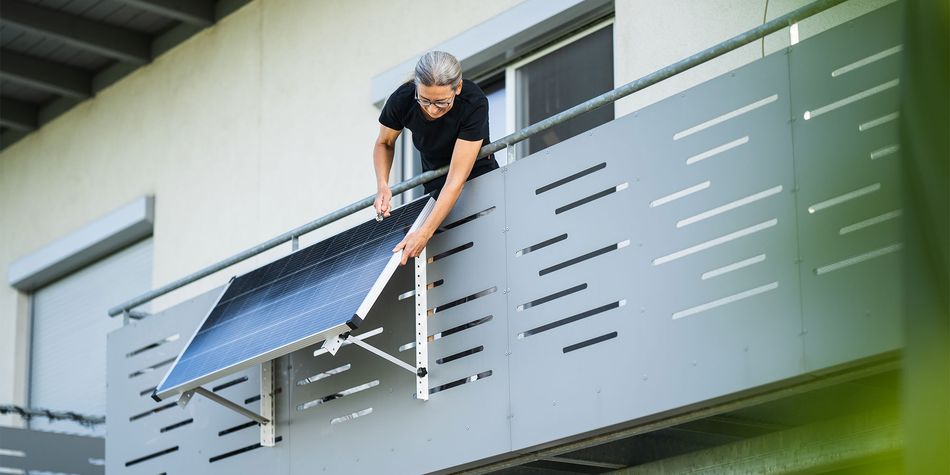
These low-cost, portable solar panels can be used on balconies or outdoor spaces to help reduce the amount of grid electricity you need to buy to power your appliances.
They're currently banned in the UK because they violate electrical safety regulations, but the government plans to update the rules to allow their sale and use in UK homes.
Plug-and-play solar panels are already widely used across Europe. In Germany, around 500,000 new solar devices were plugged in last year.
Lidl and Amazon are among retailers working with the government to bring plug-in solar to the UK.
The government said it's going 'further and faster on clean energy in response to the conflict in the Middle East'.
Live more sustainably: get our free monthly Greener Living newsletter to make eco-friendly changes for you, your home and the planet
Plug-in solar panels are solar kits that you can install yourself and plug into a standard mains socket.
They feed the electricity they generate into your home's circuit. Any appliance that is turned on will use this solar power first, reducing the electricity used from the grid.
Systems typically include one or two panels with a microinverter that converts sunlight to usable AC power.
You won't need an electrician to install them, unlike solar panels on your roof.
Plug-in vs. rooftop solar panel systems: what's the difference? See a side-by-side comparison
At the moment, we don't know what the prices of these products will be when they are available to buy. Amazon and Lidl have been named as retailers that are working with government to roll them out in the UK.
Early reports are that costs could be around £400 for a basic set up.
In Germany, where 'Balkonkraftwerk' (balcony power stations) are already popular, they're available through Ikea, which has partnered with Swedish energy company Svea Solar.
German Ikea shoppers can buy a small balcony solar system with two 450W solar panels and an inverter for around €289. The addition of a battery brings the price to €820; while this means the energy can be used at other times of day, it may make the system less cost-effective. Larger systems cost from €800-€1,500.
Other German retailers charge from as little as €200 for a basic kit to €800 for a premium option (you'll need mounting hardware and cables, which sometimes aren't included in basic packages). When they were first launched on the German market, costs were around double those figures, but prices have come down significantly as the market has grown.
The German Environment Agency (Umweltbundesamt or UBA) estimates that for an 800W system mounted vertically on a south-facing balcony, annual yield would be around 532kWh. It estimates that (without a storage battery) households use around half of this power, resulting in average bill savings of €90 a year. That suggests a payback period of three to four years for the Ikea system. However, UBA does note that an increase in grid electricity prices (currently €0.37/kWh in Germany) would shorten this payback time, as would a reduction in upfront costs.
The UK government has said it expects these products to save British households £70 to £110 a year.
The rooftop solar PV systems currently available in the UK have higher upfront costs, but generate more energy for your home. Find out how they work and how much they cost in our guide to buying solar panels
Plug-in solar panels are smaller than rooftop solar panels, so they can be installed on balconies, against walls, or in small outdoor spaces.
So they could be suitable for your home, even if a rooftop system isn't – perhaps because of the direction your roof faces or because you rent your home. They're portable, so if you move home, you could take them with you.
They come with a mounting kit, so you can choose your spot to ensure they're in the best position to catch the sun.
They're much more affordable than rooftop solar panels. But they won't be able to generate as much electricity, either, which means that the bill savings will be less. You'll need to think about the initial cost compared with the energy bill savings you'll get, as the payback time could be as long as four to five years.
They're quicker and less disruptive to install than rooftop solar PV systems. According to the government, you'll be able to do it yourself and won't need an electrician.
Crucially, they're not available yet in the UK. The government says it's working with energy networks and the regulator Ofgem to update rules and regulations so that households can connect plug-in solar panels to mains sockets without needing an electrician.
We'll keep you updated when rooftop solar panels are available to buy.
In the meantime, read our comparison of rooftop vs. plug-in solar panels, or head straight to our buying advice for solar panels.
Use our home energy planning service, powered by Snugg, to get personalised advice for a more energy-efficient home and lower bills
Start your plan