Age gaps between partners in later life aren’t particularly uncommon, but they can lead to financial pitfalls.
Around three in 10 married couples, and a third of cohabiting couples, have an age gap of five years or more, according to Office for National Statistics (ONS) data.
Financial services firm AJ Bell has pointed out that problems can emerge if one of you retires first or requires unexpected care. ‘Age is just a number, but if there’s a big age gap between a couple in later life, it can cause financial headaches,’ said AJ Bell’s head of personal finance Sarah Coles.
Read on for five financial mistakes to avoid for a smooth retirement if you and your partner have a significant age gap.
1. Not budgeting for the first retirement
As a couple, you should plan out exactly how much money you will have coming in and going out when one of you retires.
The state pension age will gradually rise from 66 to 67 between April 2026 and April 2028. The phased increase means that there isn’t a fixed state pension age for people born between 6 April 1960 and 5 March 1961; instead, it will depend on your exact date of birth. Remember to factor this in when planning for your retirement – you can find out the exact date you’ll reach retirement in our guide.
Couples with a significant age gap may see one partner retiring while the other is in their 50s. You may also need to plan for them to scale back their working hours as they approach retirement.
As a result, the younger partner may need to shoulder more of the household costs, and you may need to rethink current spending habits. Budgeting apps can help you plan for this, as well as our guide on how much you’ll need for a comfortable retirement.
2. Not factoring in care costs
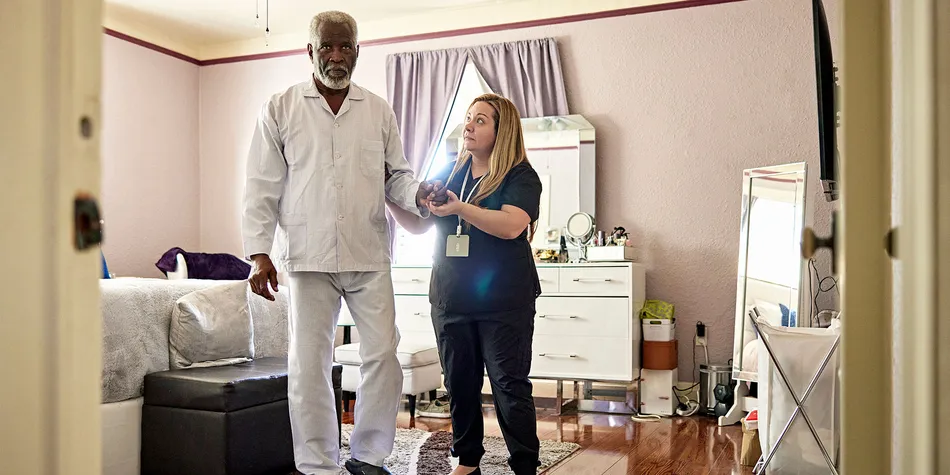
It’s possible that one of you may need care after retirement, the cost of which can be prohibitive, and potentially eating into the younger partner's working hours.
The amount you pay for care at home will depend on the level of care you need and the care provider you choose, but you can expect to pay at least the minimum rate of £34 per hour.
If they need to move into a care home, this will be even more expensive. The fact that the younger partner is likely to be living in the property means it won’t be counted as an asset when your wealth is assessed to see if you qualify for state support.
However, the older partner’s savings and investments will count, including half of any assets you hold jointly, when your local council assesses you against the upper capital limit (£23,250).
According to Coles, this means you need to consider how you hold assets.
‘You can’t just give them away to your spouse right before the means test, because the council will consider this to be a deliberate move to avoid care fees (known as deliberate deprivation of assets), and charge you regardless.
‘However, it could have an impact on how you choose to hold savings and investments right now as you prepare for this potential future.’
3. Not planning for the first death
You should have a plan in place should the worst happen and one of you dies unexpectedly.
In the first instance, make sure you have wills in place – you can use our own Which? Wills service to help you.
If the older member of the couple has a defined benefit pension, there will usually be spousal benefits, often paying half the pension to the surviving member of the couple.
Bear in mind that some schemes have rules that mean if you remarry after your partner dies, then you will lose the benefit.
‘Those who have a defined contribution pension and opt for an annuity have to decide whether they want it to pay out until their death (single life), or until they and their spouse have both died (joint life). This can be crucial for couples with age gaps and very uneven pension pots, who rely heavily on one pension,' said Coles.
4. Not budgeting for an early retirement if you want to retire together
If you plan to retire together in spite of a significant age gap, it either means one of you working far longer than they may have originally intended, or the other taking very early retirement.
In either case, you will need to do a lot of forward planning to make sure you have budgeted everything correctly.
It’s important to make sure you have a rainy day fund in a savings account for emergencies. The general rule of thumb is to have at least three to six months' worth of outgoings saved.
If one of you decides to take early retirement, you will need to work out how long you’ll have to live without the state pension before it kicks in.
Someone turning 67 in 2028, with a partner ten years younger, might have a gap of 12 years between when they both receive their state pension due to the increase in the state pension age.
Remember, if you take early retirement you risk running out of money in retirement, as well as severely limiting how much you can contribute to a pension in the future by accessing your savings early.
5. Not considering the cost of children in retirement
The age at which couples have children continues to increase; in 2025 there were 1,126 babies born with a father over the age of 60, according to the ONS – up a fifth since 2023.
Retiring while you have school-age children means you can devote more time to them, but it also comes with financial burdens. You’ll need to carefully plan out how you will raise them on a pension income.
‘You may also want to consider life insurance – not just for the older person but for the younger half of the couple,’ said Coles.
‘If they were to pass away while the child is still dependent, the older person will have to support them on a pension income. If you're in your 70s when you suddenly become a single parent, you may also need support – which can come with a price tag.’