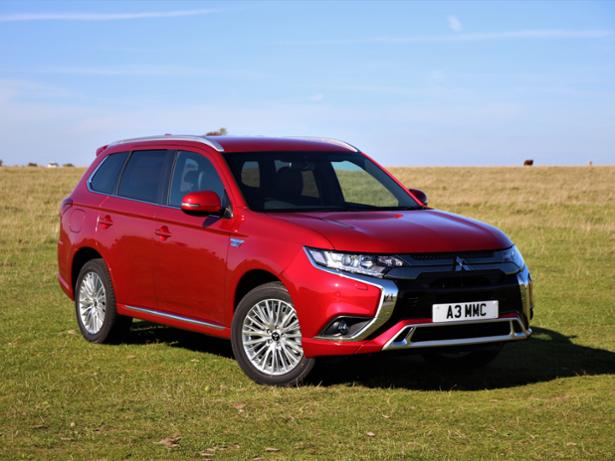
Mitsubishi
Outlander PHEV (2014-2021)
£6,373Typical price
Get Digital access £9.99 per month, cancel at any time.
Already a member?Log in

With a masters degree in automotive journalism, Dino has a forensic knowledge of the car industry and works closely with our lab to find the best (and worst) models.

Nearly all of the car brands that have launched in the UK so far this year have been Chinese. The one major exception is Mitsubishi.
Having sold cars in the UK under various brand names since 1975, Mitsubishi left the UK in 2021. Five years later, the Japanese brand is back.
Since leaving the UK, most of its cars sold in other European markets have been re-badged Renault models. But none of these cars are coming to the UK. Instead, Mitsubishi has introduced the second-generation Outlander Plug-in Hybrid (PHEV), which is a distant relation of the Nissan X-Trail and the seventh-generation L200 pick-up truck.
International Motors (the car import company that bought the UK aftersales rights from Mitsubishi in 2021) believes consumers trust the Mitsubishi name, and going by previous sales figures that may well be true; around 54,000 Outlander PHEVs were sold in the UK between 2014 and 2021. The previous-generation Outlander PHEV also performed well in the latest Which? car survey, with models aged 5-9 years scoring a full five stars for reliability.
Ahead of our full lab review, I took the Outlander PHEV for an initial drive.
Best hybrid SUVs: see the models that aced our tough and independent lab tests

| List price | £46,995 - £49,995 |
| Fuel consumption | 313.2mpg (2.4 mi/kWh) |
| Total power | 299hp |
| Battery size | 22.7kWh |
| Electric range | 53.5 miles |
| Boot space | 163 - 1,461 litres |
| Warranty | 8 years/100,000 miles |
A considerable 299hp is available from the engine and two electric motors, although the engine only powers the car when you need maximum power or when the battery is empty; it generally acts as a generator for the battery, which powers the electric motors.
Two trims are available. Entry-level Nativa cars have seven seats, a 12.3-inch touchscreen, wireless phone charger, electric boot, privacy glass, heated steering wheel and heated front seats.
Top-spec Diamond cars have five seats, an opening panoramic sunroof, brown leather seats, ambient cabin lighting, ventilated and massaging front seats, rear heated seats and rear window blinds. Yamaha audio systems are fitted to both cars.
The Outlander accelerates quickly regardless of which of the three accelerator response modes you use. There are also four other modes for different road surfaces, such as mud and snow (the Outlander is all-wheel drive).

The Outlander PHEV’s single-speed transmission is very smooth, as is the transition between the engine and the electric motor. Only when you need to accelerate quickly does the engine become intrusive as it revs up.
While the Outlander can stop quickly, I found that the brake pedal wasn’t the easiest to use as you have to press it further than expected. Its regenerative braking system can be activated with the direction selector or with paddles behind the steering wheel and has up to five different settings. If you switch driving modes, the set amount of regenerative braking changes automatically.

All trim levels come with the same suspension setup. While I found comfort respectable at high speeds, the car’s body did move a lot when driving over bumps and people in the cabin will clearly feel any potholes.
Double-glazed front side windows are standard across the range and help to reduce wind noise. But while wind noise is limited at motorway speeds, I found road noise is noticeable. Also, under acceleration the electric motors can be loud and easily heard in the cabin.
As the Outlander sits quite high above the ground, you have a good view of what's ahead of you.
Rear visibility is adequate; although the rear pillars are quite wide, the large rear windscreen improves how easy it is to judge where the rear of the car is. The headrests of the outer rear seats don’t fully retract, but aren’t completely in the driver’s line of sight so don’t always compromise visibility.
I certainly felt the car’s weight (over 2.1 tonnes) in corners and body roll was noticeable when driving on country roads. And although the steering is accurate and quite direct, which aids manoeuvring, its light nature left me feeling somewhat disconnected from the road.
Mitsubishi claims the Outlander can travel just over 50 miles on electric power alone, which isn't bad for a plug-in hybrid. However, the claimed efficiency of 2.4 miles/kWh is poor compared to its rivals (the Volkswagen Passat managed 3.34 mi/kWh in our lab tests).

The Outlander also retains the Chademo charging port found on the previous version, which allows for fast DC charging up to 50kW. However, while they're popular in Japan, Chademo chargers are much less common in the UK.
Thankfully the Outlander also has the much more common Type 2 port for slower charging, such as at home or public AC chargers.
Read our guide on how to use public charging points for more on the different types of charging port.
There’s plenty of space for even the tallest people up front, while most people will also find it comfortable to sit in the middle seats. However, legroom can be tight for tall people like me (I’m 6ft 2in).
It’s therefore welcome that the second-row seats can slide back and forth and recline to create extra space. The headrests don’t go up that high, though, which again could be an issue for taller people.

I drove the seven-seat Nativa model. With all seats in use, there’s only enough room in the rear seats for smaller children and, even then, tall passengers that sit in the middle seats won’t have much space to sit comfortably.
When the second-row seats are positioned as far back as possible, the rear seats can’t be used as there isn’t anywhere to put your legs. At least the third-row seats are easy to flip up from the boot floor. Unsurprisingly, Mitsubishi says that the Outlander is a ‘5+2’ seat car instead of a true 7-seater.

The Outlander is well-made inside and out and none of the trim rattled or squeaked during my test drive. All of the upper parts of the dashboard are soft to touch, as are the upper areas of the doors.
The steering wheel also feels classy and, unlike in other cars I’ve driven, the centre console feels solid and doesn't move when you apply pressure to it. However, the direction selector, roof lining and sun visors do feel a bit cheap, while hard plastics are used for all parts of the lower dashboard.
As you expect from a large SUV, it’s easy to get in and out of the front and middle row seats. It’s also easy to move between the middle row seats as the Outlander’s floor is nearly flat. As there’s so little space around the rear seats, it’s very hard to get in and out of them.
The front seats have narrow backrests, which some people may find uncomfortable. They’re also not shaped particularly well, which I found a bit annoying. Thankfully the driver’s seat base is quite long and its angle can be adjusted. As with many cars, the front passenger seat isn’t height-adjustable.

The boot is some way off the ground (as you’d expect from an SUV), but is otherwise easy to load as the gap between the boot floor and the rear of the car is quite small. However, it is quite small when three rows of seats are used.
When the second row of seats is folded, there’s no step between the floor and the seat backs, although they don’t fold flat and leave a large gap between the seats and the floor.
Best plug-in hybrid cars: find out which models scored best in our tests
Mitsubishi has placed a clear focus on physical cabin controls in the Outlander, which I like.
There are physical controls for climate, driving mode, temperature and volume. You also get buttons and toggles on the steering wheel.

These controls are generally easy to use, although the climate controls are positioned quite low down and the head-up display button is hidden below and to the right of the steering wheel (along with the fuel cover release button).
I found that the Outlander’s digital instrument display was easy to read and customise, although it (and the touchscreen) aren’t as modern as some cars.

All Outlander cars come with lots of safety equipment, including blind-spot monitoring, traffic-jam assist, rear cross-traffic alerts, adaptive cruise control and both front and rear autonomous emergency braking. You also get knee airbags for the driver and front passenger, along with rear-occupant detection alerts.
Most of the safety equipment worked well during my test drive, although the lane departure prevention system was occasionally quite intrusive for no reason. Its driver distraction monitor is very irritating, though, and frequently activated when I was using the centre touchscreen or scrolling through the instrument cluster for short amounts of time.
At the time of writing, this Outlander hasn’t been crash-tested by Euro NCAP.
Best car tyres: see the models that did well in our tests, and those to avoid
When we reviewed the previous-generation Outlander (2014-21), we praised its spacious interior, but took issue with some aspects.
Which? members can log in see the test score below and read the full review. If you're not a Which? member, join today to instantly unlock all our expert reviews.
Outlander PHEV (2014-2021)
Get Digital access £9.99 per month, cancel at any time.
We’ll reserve final judgement on the Outlander until we lab test it, but based on my experience it’s a well-made car that has a logically designed cabin, plenty of power and a comfortable ride.
It’s not the most practical or spacious PHEV SUV, though, while it’s considerably more expensive than some (admittedly less well-equipped) Chinese rivals such as the Chery Tiggo 9 and MG S9. However, neither brand can match Mitsubishi's 8 year/100,000-mile warranty.
It's worth noting that the Outlander’s insurance could also be quite expensive as it sits in insurance group 47 (out of 50), so we recommend getting a car insurance quote before purchasing. And like all PHEVs, the Outlander will be subject to additional car tax from spring 2028.
Best cars for 2026: whatever car you're thinking of buying, make sure it's a Which? Best Buy