James Rowe: Seeking out deals on supermarket products is nothing new, but our research has found some branded products that you never need to pay full price for.
Hello and welcome to Which? Shorts, your free weekly insight into Which? magazine, as well as our money, tech, travel, and gardening titles too. Today I'm bringing you a piece that our retail expert, Ellie Simmonds, wrote for the July issue of Which? magazine, all about the groceries you should never pay full price for. Our investigation analysed the pricing of thousands of popular branded groceries over a year to uncover the truth about grocery promotions. Here we reveal the tricks of the trade and teach you how to see through the smoke and mirrors of grocery pricing.
Here is Ellie's piece, adapted for the podcast, this week read by me, James Rowe.
The price of groceries has rarely left the headlines over the past few years, and now, yet another wave of food inflation looks set to hit shoppers. The conflict in the Middle East has made the cost of fuel and fertiliser soar, sending shockwaves through global food and drink supply chains. Our inflation tracker shows the price of supermarket food and drink was up 2.4% in May compared to the same period the year before, but experts warn it could hit double figures by the end of the year.
As a result, more shoppers are looking for deals. Spending on grocery promotions rose nearly 8% year on year, according to analysts' Worldpanel by Numerator. Indeed, about a third of what we spend on groceries is on so-called deals. But the truth about grocery pricing is more complex than it first appears. We found that deals on some branded groceries are so common that you never need to buy them at full price at all.
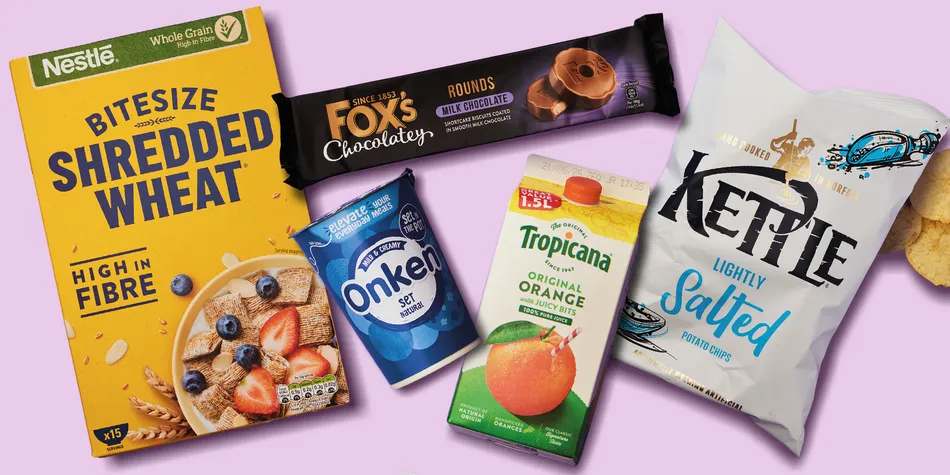
These include Fox's Chocolatey Milk Chocolate Rounds, Jammie Dodgers Raspberry Biscuits, Penguin bars, Special K cereal, Mini Cheddars, Twiglets, Kettle Chips, Tropicana orange juice, and Onken yogurt – some of which you may have bought before, but all of which were on offer at one major supermarket or another every single day of the year.
Let's take one product as an example: a 440g box of Kellogg's Special K Original cereal. This had a full price of between £3.30 and £3.50 at the major supermarkets throughout the year. But if you shopped around, you would have always been able to buy it somewhere for £2.85 or less. In reality, it's unlikely we'd shop around just for a deal on one box of cereal, but it illustrates a wider point – you should take some full prices with a pinch of salt.
Grocery deals can also last a long time, so you don't need to rush. That same box of Special K was on promotion at Ocado 51% of the year. At Tesco 50%, Waitrose 48%, Sainsbury's 45%, Asda 29%, and Morrisons 29% – with a discounted price as low as £2.63. On grocery promotions more widely, they tend to follow a pattern. Usually, products will stay three or four weeks at a lower price, followed by slightly longer at a higher price, repeating almost indefinitely.
These cycles led to some crazy prices. One of the most striking was a four-pack of Light & Free Peach Passion Fruit Greek Style Yogurt: £1 at Ocado at its lowest price and £2.90 at its highest at Waitrose – a difference of 190%. But you don't always need to shop around to bag low prices. Even at the same supermarket, we found price fluctuations of up to 213%. At Asda, a 200g pack of Amaara Plain Poppadoms were 48p at their cheapest and £1.50 at their most expensive. So don't assume the full price of branded groceries is what you should pay. It's usually way over what you could be paying elsewhere or at another time. If you're able to stock up on non-perishable, freezable, or frozen groceries when they're discounted, then you should.
If you're wondering why these rollercoaster prices are like this, it's not necessarily down to the supermarkets. They do set the prices, but these are influenced by the manufacturer and other supply-chain costs. Manufacturers work with supermarkets to plan when deals will happen and what type of promotions to use. Each manufacturer will allocate a budget to fund promotions, and these will be scheduled in advance at different supermarkets. Manufacturers also look at whether they are offering the right types of pack sizes or formulations. Brands commonly tweak products for discount supermarkets such as Aldi or Lidl, for example.
Retail analyst Brian Roberts, from the Institute of Grocery Distribution, suggests shoppers should cherry-pick products based on promotions. He said a little bit of legwork really can pay dividends. But there can be tension between brands and supermarkets. Filippo Berio boss, Walter Zanre, recently accused supermarkets of taking the micky out of shoppers for not reducing prices in line with the falling costs of olive oil.
Of course, you could opt for own-label products, which are generally cheaper than bigger name brands and can taste just as good. At our champagne tasting, one expert – a Master of Wine no less – said she would serve our Best Buy at a forthcoming celebration. It wasn't a fancy, well-known label, but a supermarket own brand. In our latest extra virgin olive oil test, we invited four experts to a blind tasting and they unanimously judged one sample greasy, astringent, and unpleasant. It turned out to be a bottle relying on a slick design, a snazzy logo, and on-trend packaging, rather than flavour. By contrast, three olive oils stood out – all from supermarkets. These supermarket products can be under half the price of big brands, yet they don't seem to sacrifice taste or quality.
If you do prefer buying branded groceries, you'll find our newly launched monthly price tracker useful. It reveals just how stark the price differences are between supermarkets on branded groceries such as Heinz beans, Nescafé coffee, and Mr Kipling cakes. So far, Asda has been the cheapest for branded groceries, with Tesco and Sainsbury's most expensive for those without a loyalty card – pricier even than Waitrose or Ocado. It shows that switching offers big savings.
James: That brings to an end another podcast from Which? There's loads more for you to read about everything we discussed today – just head to the episode description for more useful everyday advice. There you'll also find an exclusive offer for podcast listeners like you to become a Which? member for 50% off the usual price, giving you access to our product reviews, our app, one-to-one personalised buying advice, and every issue of Which? magazine across the year. Plus, your membership helps us to make life simpler, fairer, and safer for everyone. If you'd like to know when we release a new episode, then make sure you press subscribe wherever you're listening. That way you can be one of the first to listen. And for any questions, comments, or anything in between, follow us on social media @WhichUK or email us: podcasts@which.co.uk