By clicking a retailer link you consent to third-party cookies that track your onward journey. This enables W? to receive an affiliate commission if you make a purchase, which supports our mission to be the UK's consumer champion.
Best car insurance for the over-50s 2026
We surveyed over 3,000 UK car insurance customers to find out who delivered the best service for policy holders over 50
We asked 3,464 car insurance customers who've made a claim in the last two years to score their insurer.
Expert analysis
We rated 94 elements of each policy and drew on claims and complaints data from the Financial Conduct Authority and Financial Ombudsman Service.
Best car insurance when you're over 50
Your 50s and 60s should be among your cheapest years for car insurance – provided you pick the right policy. Yet as you get older, costs can begin to rise, and some insurers may entirely refuse to take you on.
Based on our comprehensive research, we reveal the best insurers for older drivers and explain how to get cheaper cover.
Please note that this article is for information purposes only and does not constitute advice. Please refer to the particular T&Cs of an insurer before committing to any financial products.
Table note Last updated in January 2026. Next update in January 2027. Standard policy score Our assessment of the overall quality of cover in the provider's standard policy based on examining 94 elements of each policy. For all 66 policies we've reviewed, see our guide to the best and worst car insurers.Customer survey Based on an online survey of 3,464 members of the general public who had made a claim in the past two years. Survey conducted in November 2025. Sample sizes given below. Customer score reflects the general satisfaction of customers with their insurer and their likelihood of recommending it. Claims score reflects customer satisfaction with the handling of their most recent claim and the likelihood of recommending the insurer.
Customer score/claims score sample sizes 1st Central (160/146), AA (783/760), Admiral (564/534), Ageas (66/99), Age UK (41/46), Allianz (131/145), Aviva (529/520), AXA (178/196), Churchill (187/163), Direct Line (253/264), Esure (51/56), Halifax (71/63), Hastings Direct (169/163), Lloyds Bank (104/101), LV (509/513), NFU Mutual (106/106), RAC (64/57), Saga (78/87), Tesco (131/134)
Best over-50s car insurance providers and policies
We compared 25 car insurance providers, examining the cover in their policies and analysing feedback from thousands of claimants. Only one was assessed to be a Which? Recommended Provider, but several other providers' policies also caught our eye.
Recommended Provider
Aviva
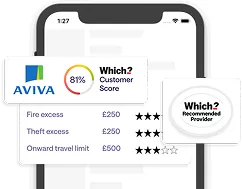
This year, Aviva was our sole Which? Recommended Provider. Claimants found it to be both affordable and to offer comprehensive cover. If your car is damaged by a pothole, you can claim without sacrificing your no-claims discount.
LV's policy was our third-highest rated. It offers a guarantee on its repairs for as long as the policyholder continues owning the car, and protection for no-claims discounts against an unlimited number of claims.
Figures from MoneySupermarket from the first six months of 2026 show that, generally speaking, getting older means paying less for car insurance; younger drivers typically pay the highest premiums, while those in their 60s pay the least. This is largely because younger drivers have less experience and are also most likely to claim.
However, as our chart shows, the trend reverses after the age of 70, at which point premiums start rising again. This is because, according to ABI data, after the age of 70 insurance claims frequency starts to rise.
And, equally importantly, the average claim size is higher for those aged 86 and over than it is for very young drivers. This likely reflects the higher costs of medical care and longer recovery periods if an older driver has an accident.
Source: MoneySupermarket. Based on average annual premiums for car insurance policies sold through MoneySuperMarket between 01/01/2026 and 0/07/2026, covering full UK car licence holders, with a minimum of 100 sales.
Is car insurance cheaper if you're retired?
Probably, but the difference isn't huge.
Data from MoneySuperMarket suggests that one of the advantages of retirement may be a reduction in car insurance premiums – albeit a small one. Based on MoneySuperMarket data on premiums paid via its site over the first six months of 2026, retired over-60s pay an average of £430 a year for car insurance, while non-retired over-60s pay £470, working out as £40 more.
Reasons for this include the fact that retired drivers are usually more experienced on the road, they typically drive fewer miles, and they may be able to avoid driving during busy rush hours.
It's vital you tell your current insurer you've retired, in case the premium does fall, and seek quotes from other providers to see if you'd be better off elsewhere.
Some insurers market their products specifically to older drivers, typically those over the age of 50.
Generally speaking, they will have high maximum age limits and emphasise features they think older drivers will value.
For instance, Saga provides very generous levels of cover for driving overseas – a full year's comprehensive cover – in its Select and Plus policies.
However, when shopping around, consider as much of the market as possible.
Don't feel you have to go for a specialist policy. In our analysis of standard car insurance policies, we found that:
the average maximum age was 85
three in 10 policies had a maximum age of 90 or higher, with policies from Moja and Saga having no maximum age.
Is over-50s car insurance cheaper?
Be warned: over-50s cover may not be cheaper than standard car insurance.
All insurers take numerous factors into account when setting your premium, not just your age. And with many more insurers offering standard policies than over-50s policies, there's more competition between standard providers.
If you're looking for the cheapest car insurance, you should seek quotes from different comparison sites, plus insurers that aren't on them, such as NFU Mutual.
Our guide to getting cheap car insurance includes everything from tweaking your cover to cut costs to haggling with your insurer.
Age plays a big role in the prices car insurers set for drivers. The youngest tend to pay the most. From there on, for much of your driving life, as a general rule of thumb, your age works in your favour.
According to data from Confused.com, the lowest premiums are paid by drivers aged 60-69, who paid an average of £452 in Oct-Dec 2025. After this point, though, your age might mean your premiums begin to rise again.
You don't need a 'specialist' insurer to get lower premiums. True, these providers may have carefully researched what their target customers are likely to want in their insurance, but of course, there's much more to you than your date of birth.
Think carefully about the cover you want, and make a list of these requirements. Then look around widely (comparison sites make this fairly easy) to find insurers that meet these needs for the most reasonable price.
Check you're getting a great deal and search for a new car insurance policy using the service provided by MoneySuperMarket. Get a quote now
Over-50s car insurance FAQs
Pay-per-mile car insurance is a type of insurance where you pay a lower-than-normal baseline premium, and make an extra payment for each mile you drive.
It's a form of black box (telematics) insurance, which only records your mileage and not other aspects of your driving behaviour.
It's worth considering if your mileage drops off considerably as you get older – for example, if you retire and no longer need to commute. As a rule of thumb, if you drive less than 6,000 miles a year, pay-per-mile car insurance may work out cheaper than a standard policy.
Not necessarily - in fact your 50s and 60s could be your cheapest decades for car insurance.
On average, younger drivers pay some of the highest premiums, and then as you get older, car insurance costs decrease (at least compared with premiums paid by drivers of other ages).
However, this trend reverses once you pass your seventies and premiums begin to rise.
Car insurance should be (relatively) cheap in your 60s. If you're finding your premium rising, get quotes from other insurers - you should still have access to standard car insurance policies.
Update insurers about changes in your circumstances, such as retiring or moving home, as this could affect your premium.
In your 70s, insurers may begin to raise premiums. But it's still worth shopping around as you'll still be able to get standard policies.
Those aged 80 and above may start running up against some insurers' maximum ages. With many insurers having no maximum age, however, this shouldn't force you off the road.
Yes, car insurers can refuse to cover you if you're above their maximum age.
Equalities legislation doesn't stop insurers having age limits or pricing by age.
But this maximum age can vary hugely, and some insurers don't have a maximum age. Shop around, using different comparison sites, and consider insurers that aren't on them, such as NFU Mutual.
There is no age at which you have to stop driving.
At age 70, you need to renew your driving licence. You then have to renew every three years. The DVLA will send you a D46P form 90 days before your 70th birthday, or you can renew on the DVLA website.
Renewing is free and doesn't involve a test, but make sure you use the government's websites, as various copycat sites may attempt to charge you. You can drive while you're waiting for your license to be renewed.
They may not stop you driving, but could make you do another driving test, and the insurer may raise your premium.
How we analyse car insurance
Our editorial independence means we work on behalf of consumers, not insurers. Our reviews are fair, and there's no hidden agenda.
Customer score
This is based on a survey of 3,464 policyholders (adults of all ages) who have recently made a car insurance claim. The score reflects how satisfied customers say they are with their provider and how likely they would be to recommend it.
Insurers must receive a minimum of 40 customer responses to be included.
Policy score
This is our assessment of the quality of standard cover, comparing 94 elements of a policy. We weigh certain features of cover or costs (fees and excesses) based on the impact we think they generally make, from courtesy cars to replacement keys.
Among the highest-weighted elements are the insurer's guarantee on repairs, cover for glass damage, conditions of its no-claims discount, whether it'll provide a replacement vehicle, its fire, theft and accidental damage excesses, and interest rates charged for paying premiums in instalments.
We carry out this analysis every 12 months. The next update will be in January 2027.
Got more questions on car insurance? Take a look at our guides: